Your regional director says stores are understaffed. Store managers say the issue is not headcount, but capability. HR sees turnover in one territory, disengagement in another, and rising absence in a third. The executive team asks one question: do we hire, train, move people, or fix the operating model?
Most retail organizations cannot answer fast enough.
They have dashboards, exit data, engagement scores, learning records, applicant tracking reports, and workforce planning spreadsheets. Yet the decisive signal is often missing: what employees are actually experiencing in stores, warehouses, contact centers, and field teams before performance drops or resignation letters arrive.
That is the problem retail talent intelligence should solve.
Short Answer: Retail Talent Intelligence Connects Store Reality To Workforce Decisions
Retail talent intelligence is the ability to understand what is happening across distributed teams before weak signals become turnover, capability gaps, poor service, or missed sales.
The strongest systems combine five layers:
| Retail talent intelligence layer | What it answers | Why it matters |
|---|---|---|
| Workforce structure | Which roles, locations, contracts, tenure groups, and shifts are under pressure? | Gives HR and operations a reliable map |
| Skills and task reality | Which product, service, stock, digital, or leadership skills are missing in practice? | Connects learning to work, not only job architecture |
| Employee conversations | What do frontline teams say is changing, blocking, or helping performance? | Captures context that systems of record miss |
| Retention signals | Where does friction deserve human attention before attrition hardens? | Guides support without reducing people to risk scores |
| Craft transmission | Which strong-team practices should be reused elsewhere? | Turns local excellence into organizational learning |
For Lontra, retail talent intelligence is a Craft Intelligence use case. The goal is to transform employee conversations into living memory, make the organization interrogable, reveal the craft of the strongest teams, and transmit that know-how to the teams that need it.
Nothing is automatic. Signals guide human decisions; they do not replace them.
Why Retail Talent Intelligence Is Different
Retail talent intelligence is the continuous understanding of workforce skills, motivation, constraints, and retention signals across distributed teams. In retail, it must connect store-level reality with strategic workforce decisions: where to hire, where to train, where managers need support, and where operating pressure is becoming unsustainable.
Generic talent intelligence often starts with labor market data, job postings, CVs, skills taxonomies, and competitor hiring patterns. Those inputs matter. Lightcast, for example, emphasizes the value of external labor market context and reports that the average job has seen 32% of its skills change over three years. That is useful for workforce planning.
But retail has a second layer: live operational truth.
A store associate may know exactly why new hires leave after their first month. A department manager may see which product knowledge gaps hurt conversion. A warehouse team may understand why training content is not landing. These signals rarely appear cleanly in structured HR systems.
Retail talent intelligence becomes useful when it combines workforce data with the words, patterns, and repeated observations of employees close to the work.
Why Traditional Approaches Miss the Signal
Traditional retail listening methods were built for measurement, not understanding.
Annual engagement forms are too slow. Pulse forms are faster, but still constrained by fixed questions. Manager interviews depend on availability, trust, and consistency. Exit interviews arrive after the damage is done. HR business partners can interpret patterns, but they cannot personally interview thousands of employees across countries every month.
The result is a familiar gap: leadership sees the metric but not the mechanism.
A region may show higher turnover. But is the cause scheduling instability, weak onboarding, manager behavior, pay perception, commute constraints, lack of progression, product complexity, or team fatigue? A form can ask employees to choose from a list. It cannot follow the thread when the answer is nuanced.
This matters because retail work is contextual. The same engagement score can hide different realities across stores. One team may be struggling with rota fairness. Another may lack confident supervisors. Another may be losing experienced people because promotion pathways are invisible.
Retail talent intelligence should not reduce this complexity into a single score. It should make the organization interrogable.
The Alternative: Adaptive Individual Conversations
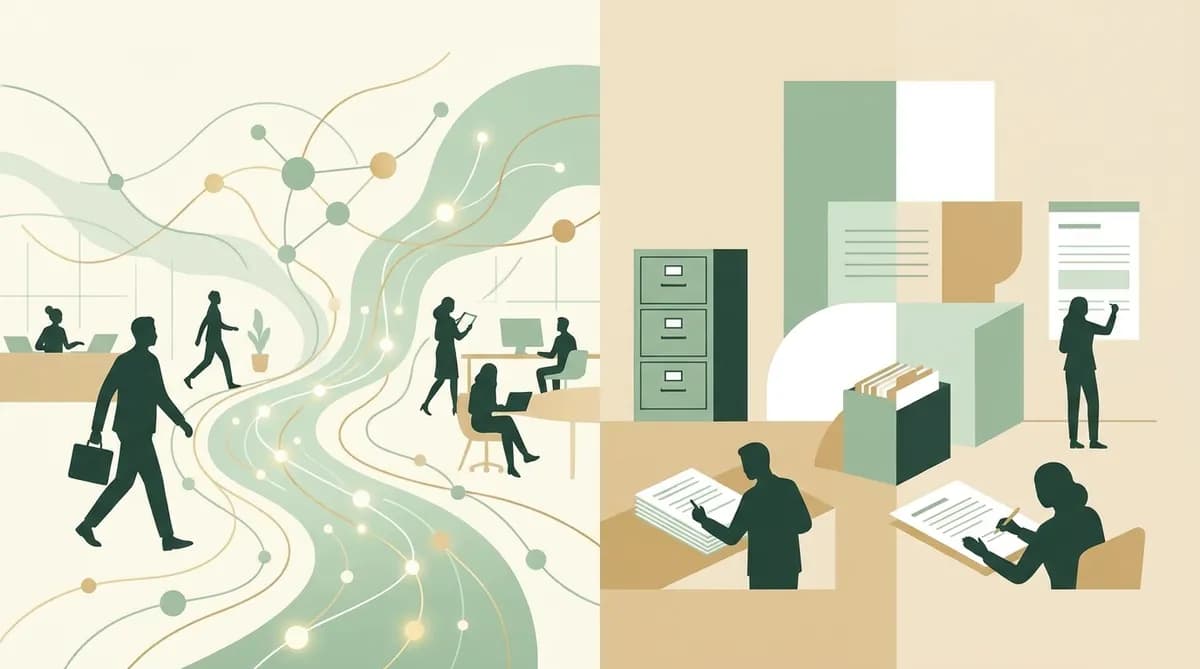
There is another way: adaptive individual conversations that capture qualitative data continuously, across languages, roles, and locations.
Instead of asking every employee the same fixed questions, the conversation adapts to what the person says. If an employee mentions onboarding confusion, it explores the moment where confusion appeared. If a manager mentions skill gaps, it asks which tasks, which teams, and what support would change the outcome. If a pattern repeats across stores, leaders can see it before it becomes a crisis.
This is not about replacing human judgment. Nothing is automatic. The role of the system is to reveal patterns, preserve context, and help leaders ask better questions.
For retail leaders, the advantage is practical. Conversations can surface:
- Skills gaps by store, role, product category, or region
- Onboarding friction before early attrition becomes visible
- Retention risks linked to operating conditions, not only sentiment
- Hiring needs several months ahead of visible capacity gaps
- Manager support needs based on repeated employee observations
- Local best practices that should be transmitted to similar teams
This is the shift from cold data to live workforce signals. Cold data tells you what has already been declared, recorded, or closed. Live signals capture what is emerging now.
What Competitor Approaches Get Right, And What They Miss
The current talent intelligence market is strong on external context. Recruiting firms focus on talent pipelines, market mapping, succession, and executive hiring. Labor market platforms focus on jobs, skills, supply, demand, and competitor movement. Analyst frameworks connect talent intelligence with workforce planning, internal mobility, and business strategy.
Those are valuable pieces. They help answer: what skills exist in the market, where talent is available, how roles are changing, and how competitors are hiring.
But retail CEOs and CHROs also need answers that cannot be inferred from job postings or profiles:
- Why are experienced employees leaving one store format but staying in another?
- Which teams have informal expertise that should be captured and shared?
- Which new skills are missing because the work has changed faster than training?
- Which managers are creating confidence, and what exactly are they doing?
- Which operational irritants are quietly becoming retention issues?
Retail talent intelligence has to listen inside the organization, not only observe the market outside it.
A Practical Model For Retail Leaders
A useful retail talent intelligence model has four layers.
1. Workforce structure. Start with roles, locations, tenure, contracts, mobility, absence, turnover, and hiring demand. This gives leaders the map, but not the terrain.
2. Skills and task reality. Connect formal skills data with what employees actually do: product knowledge, customer handling, stock routines, digital tools, escalation moments, and local workarounds.
3. Conversational signals. Capture recurring themes from individual conversations: what blocks performance, what helps people learn, what makes them stay, and what causes friction.
4. Decision loops. Feed the signal back into action: onboarding changes, manager coaching, targeted training, workforce planning, internal mobility, and retention interventions.
The fourth layer is where most programs fail. Insight without a decision loop becomes another dashboard. Retail leaders need a rhythm: listen, reveal the signal, transmit what works, measure the next cycle.
Proof: An Anonymized Multi-Site Workforce
An anonymized multi-site organization replaced traditional employee forms with adaptive individual conversations.
The goal was not to collect more data for its own sake. The goal was to understand what store and field teams were experiencing, across countries, languages, and operating contexts, while preserving trust. Employees were able to express what mattered in their own words. Leaders could then detect recurring signals, compare patterns across territories, and identify where action was needed.
The result: completion multiplied by 4 compared with the previous approach.
That matters because completion is not a vanity metric in retail. Low participation means leadership hears from a narrow slice of the workforce. Higher participation means the signal becomes more representative across countries, roles, and store environments.
An anonymized multi-site organization with a large distributed workforce multiplied completion by moving from static forms to adaptive individual conversations.
Anonymized case
What To Measure Beyond Completion
Completion matters, but it is only the first gate. Retail leaders should evaluate retail talent intelligence on whether it improves decisions.
Track signal quality: are employees giving specific, contextual answers, or generic comments? Track pattern detection: can HR see recurring issues by role, store format, region, and tenure? Track actionability: does each theme point to a decision owner? Track closure: did the organization act, communicate, and measure again?
The best test is operational. If the system reveals that one region has onboarding friction, can HR identify the exact moment where new hires lose confidence? If one store format retains better, can leaders capture the behaviors that explain it? If product knowledge gaps are hurting performance, can training teams see which teams need what?
Retail talent intelligence should help leaders move from broad diagnosis to targeted transmission.
Trust Is The Operating Constraint
Employees will not share useful signal if they believe the conversation is a control mechanism. That is especially true in retail, where frontline teams may already feel measured by conversion, productivity, absence, and customer feedback.
Trust requires clear boundaries. Employees need to know why the conversation exists, how data is protected, what will be shared, and what will not be used against them. Leaders need aggregated patterns, not intrusive individual tracking. Legal and security teams need GDPR-compliant architecture, European hosting when required, and a defensible data model.
This is why the language matters. Retail talent intelligence is not a way to police employees. It is a way to make organizational knowledge visible so human leaders can make better decisions.
The Executive Question
For a CHRO or CEO, the question is not whether retail needs more people data. It already has plenty.
The question is whether the organization can hear what its people know before that knowledge becomes turnover, poor service, missed sales, or another late dashboard.
Retail talent intelligence works when it captures the living expertise of employees, reveals the patterns that matter, and helps leaders transmit what the best teams already know. In retail, that is the difference between reacting to workforce problems and building an organization that can learn from itself.
Sources
- Lightcast, talent intelligence: https://lightcast.io/why-lightcast/talent-intelligence
- Josh Bersin, understanding talent intelligence: https://joshbersin.com/understanding-talent-intelligence-a-primer/
- Eightfold AI, understanding talent intelligence: https://eightfold.ai/learn/understanding-talent-intelligence-what-to-look-for-and-how-to-choose/
- SeekOut, introduction to talent intelligence: https://www.seekout.com/blog/introduction-talent-intelligence/
- Randstad Enterprise, talent intelligence insights: https://www.randstadenterprise.com/insights/talent-intelligence/
Frequently Asked Questions
What is retail talent intelligence?
Retail talent intelligence connects workforce data, store-level context, employee conversations, skills signals, and operational patterns so leaders can understand where to hire, train, support managers, or transmit stronger team practices.
It is most valuable when it links central HR data with what employees and managers close to the work are seeing every day.
Why is retail talent intelligence different from generic talent intelligence?
Generic talent intelligence often emphasizes labor market data, skills taxonomies, and external talent supply. Retail also needs live operational signals from stores, warehouses, field teams, and frontline managers.
The reason is practical: retail performance depends on local execution, manager practice, schedule reality, product knowledge, customer pressure, and team rituals.
What signals should retail leaders track?
Useful signals include onboarding friction, product knowledge gaps, manager support needs, scheduling tension, role clarity, retention signals, internal mobility appetite, and the practices that help strong teams perform.
The key is not to track everything. It is to capture the signals that help human leaders decide what to change next.
Can AI decide which retail employees are at risk?
No. AI can organize patterns and surface signals, but retail talent decisions should remain contextual, accountable, and reviewed by humans.
The responsible use case is not labeling people. It is helping HR and operations understand where attention, support, or knowledge transmission is needed. Nothing is automatic.
Where does Lontra fit in retail talent intelligence?
Lontra is a Craft Intelligence platform. It turns employee conversations into living memory, makes the organization interrogable, reveals strong-team know-how, and transmits it to the teams that need it.
For retail, that means store and field knowledge can become a reusable asset instead of staying trapped in local teams.