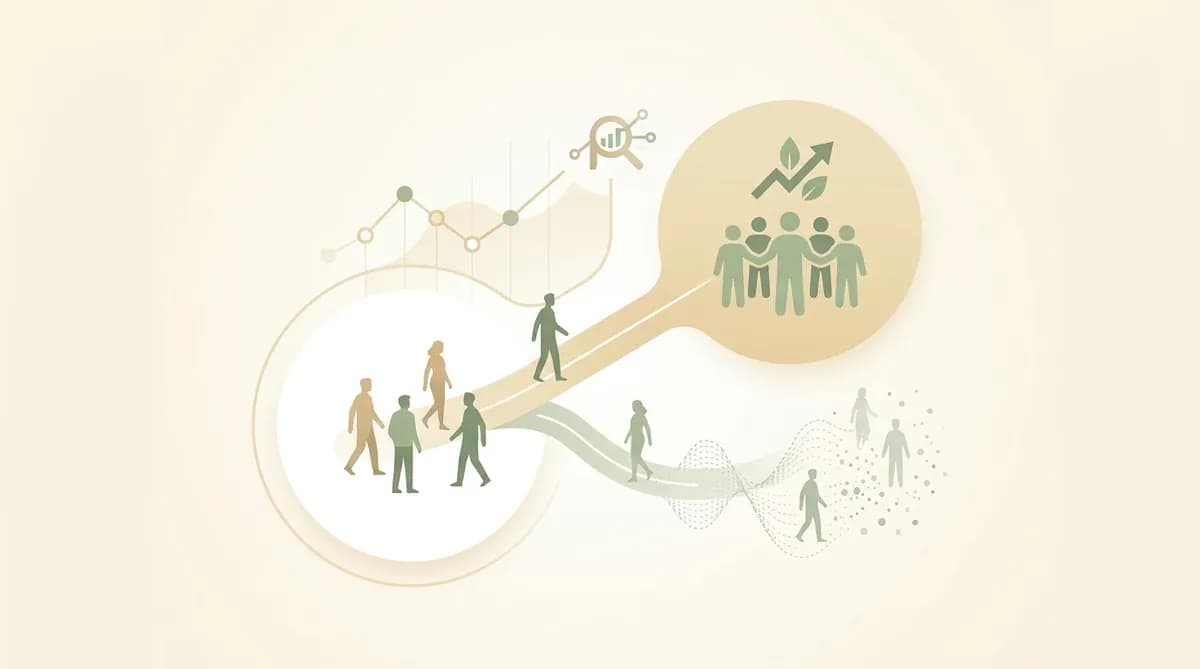
Your leadership team asks a familiar question: where are our critical skills, who can move into the next role, and which teams will break under the next growth plan?
The answer should already exist. It sits across performance reviews, manager notes, HRIS fields, learning records, engagement campaigns, exit interviews, and informal conversations. Yet when a CHRO needs a view of capability by region, role, tenure, or business unit, the map is often partial, outdated, and overconfident.
That is the core problem with enterprise talent mapping: the enterprise has more people data than ever, but too little of it explains what people can actually do, what they want to become, and where capability is quietly weakening.
What is enterprise talent mapping?
Enterprise talent mapping is the structured process of identifying current skills, future capability needs, succession options, mobility paths, and workforce risks across a large organization. It connects people, roles, skills, aspirations, and business priorities so leaders can plan hiring, development, retention, and redeployment with evidence rather than intuition.
Traditional guides usually describe talent mapping as a combination of org charts, role inventories, performance data, skills matrices, and succession plans. That foundation matters. But in large companies, it is no longer enough. Static mapping tells leaders what was declared. It rarely captures what is emerging.
Why traditional talent mapping breaks at enterprise scale
Most enterprise talent mapping programs rely on three inputs: forms, manager interviews, and system records. Each input has value. Each one also introduces distortion.
Forms compress complex careers into boxes. Employees select predefined skills, rate themselves, or answer engagement questions that may not match their actual work. Manager interviews add context, but they also reflect visibility bias: managers know the people they work closely with, not necessarily the hidden expertise inside adjacent teams.
System records are colder still. Job titles, training completions, certificates, and performance ratings can describe formal history. They do not reliably reveal informal know-how, appetite for mobility, blockers to growth, or the reason a high-performing employee is no longer speaking up.
This is why enterprise talent mapping often becomes a documentation exercise. The map is created, presented, and filed. Six months later, the business has shifted.
The readiness gap is now visible outside HR. In March 2026, HR Executive reported that nearly two out of three business leaders see data and advanced technology skills gaps in their organization, while less than half provide basic literacy training. The issue is not only skills supply. It is that leaders often cannot trust the data underneath their workforce decisions.
Static data vs live workforce signals
Static talent data is information captured at fixed moments: annual reviews, HRIS updates, job architecture exercises, learning completions, and self-declared profiles. It is useful for structure, compliance, and baseline reporting, but it ages quickly when roles, teams, markets, and employee expectations change.
Live workforce signals are qualitative patterns captured through ongoing employee conversations. They reveal what people are learning, where work is blocked, which skills are used in practice, which managers transmit know-how well, and which teams are developing capability faster than the formal system can record.
Enterprise talent mapping becomes more useful when both layers work together. The HRIS says who someone is on paper. The conversation reveals what they know, what they are ready for, and where the organization is failing to see them.
The missing layer: adaptive individual conversations
There is another way to build the map: ask employees better questions, adapt the conversation to what they say, and continuously translate the answers into structured signals.
This does not mean replacing managers or letting software make workforce decisions. It means giving the organization a listening layer that can hold thousands of individual conversations, in the employee’s language, at the right moment, with enough trust to capture nuance.
A traditional talent mapping question might ask: “Which skills do you want to develop?” An adaptive conversation can go further:
- “Which part of your role do colleagues ask you for help with?”
- “What skill are you using that is not visible in your job title?”
- “Where do you feel blocked from taking the next step?”
- “If we needed someone to train new joiners in your area, who would you trust?”
- “What changed in your work over the last six months?”
Those questions produce different data. They reveal craft, tacit knowledge, informal mentors, fragile teams, and emerging gaps before they appear in attrition data or hiring requests.
Josh Bersin’s February 2026 analysis of the enterprise learning technology market describes a shift from formal training toward content, enablement, and work-embedded support. Talent mapping needs the same shift: from cataloging roles to understanding how knowledge actually moves through the organization.
A practical enterprise talent mapping framework
A modern enterprise talent mapping program should combine five layers.
1. Role architecture
Start with the work the business needs done. Define critical roles, adjacent roles, and future roles tied to strategic priorities. This anchors the map in business reality, not generic competency libraries.
2. Current capability
Use HRIS records, performance reviews, learning history, and manager input to establish a baseline. This layer answers: who is where, doing what, with which formal skills?
3. Conversational signal
Add adaptive employee conversations to capture what formal systems miss: hidden expertise, mobility appetite, blockers, confidence, team-level knowledge gaps, and informal learning patterns.
4. Risk and readiness
Connect capability to business exposure. Which roles have weak succession depth? Which teams depend on one expert? Where is growth constrained by missing knowledge rather than missing headcount?
5. Action loop
A talent map is only useful if it changes decisions. Feed signals into workforce planning, internal mobility, learning priorities, retention actions, and manager enablement. Review the map continuously, not annually.
Example: mapping craft in a global retailer
A global retailer with 90,000+ employees across 40+ countries faced a familiar problem. Standard listening methods produced weak completion and limited operational detail. Leaders could see turnover, engagement trends, and regional metrics, but they could not clearly see where frontline know-how lived or why certain teams transmitted practices better than others.
The company replaced broad, static questionnaires with adaptive individual conversations. Employees were not asked to fill another form. They were invited into a focused exchange that adapted to their context, role, and language.
The result was not just higher participation. Completion was multiplied by 4. More importantly, the organization began to see patterns that had been invisible: which teams had strong informal trainers, where onboarding knowledge was inconsistent, which managers created confidence, and where capability gaps were likely to affect performance before they became hiring problems.
That changed the use of talent mapping. It moved from a succession document to a living memory of how work was learned, shared, and blocked across the business.
A global retailer with 90,000+ employees multiplied their completion rate by 4 by replacing surveys with adaptive individual conversations.
Deployed across 40+ countries
Enterprise talent mapping metrics that matter
The strongest talent maps do not only measure coverage. They measure decision quality.
Track:
- Critical role coverage: roles with named internal successors or adjacent talent pools.
- Hidden skill discovery: employees with relevant expertise not visible in formal records.
- Mobility readiness: employees open to internal movement and the conditions required.
- Knowledge concentration: teams dependent on a small number of informal experts.
- Capability gap lead time: how early gaps are detected before hiring or performance pressure.
- Conversation completion: whether employees actually participate in the mapping process.
- Action conversion: signals that become learning, mobility, retention, or hiring decisions.
Avoid treating the map as a scorecard for ranking people. The point is not surveillance. The point is to make the organization more legible to the humans responsible for it.
Where enterprise talent mapping fits in the HR stack
Enterprise talent mapping sits between talent intelligence, workforce planning, learning, and retention. It should not be isolated in a succession planning tool.
For comparison, talent intelligence helps organizations understand skills, labor markets, and internal capability. Talent intelligence platforms often aggregate data from multiple systems. Talent mapping gives that intelligence a concrete operating model: which people, roles, skills, gaps, and actions matter now?
The most useful stack connects:
- HRIS for identity, role, and organizational structure.
- Performance reviews for formal evaluation.
- Learning systems for development history.
- Engagement and exit conversations for lived experience.
- Adaptive conversations for live qualitative signal.
- Workforce planning for business action.
The leadership question
Enterprise talent mapping is not a prettier org chart. It is a way to answer a strategic question: do we know what our people can teach the business, and where that knowledge is at risk?
Static data will remain necessary. But it cannot carry the full burden. The next version of talent mapping will come from conversations that reveal craft, context, and readiness continuously, with clear governance and human decision-making at the center.