Exit Interview vs Stay Interview: Why Choosing Is the Wrong Question
Your best engineer just resigned. HR scrambles to schedule an exit interview. Two weeks later, you get a transcript full of diplomatic non-answers: "better opportunity," "personal reasons," "time for a change."
Meanwhile, the three engineers sitting next to her — the ones who watched her leave and are now updating their own CVs — hear nothing from anyone.
This is the trap most organizations fall into when debating exit interview vs stay interview. They treat it as an either/or choice, when the real problem is neither format captures what matters, when it matters.
What Exit Interviews Actually Tell You
An exit interview is a structured conversation with a departing employee, designed to understand why they are leaving and what the organization could improve. It typically happens during the notice period, conducted by HR or a direct manager.
The concept is sound. The execution is where it breaks down.
The Work Institute's 2023 Retention Report found that roughly three out of four voluntary departures are preventable. Yet exit interviews consistently fail to generate actionable data in time to prevent the next departure. There are structural reasons for this:
- Timing is fatal. By the time someone sits for an exit interview, the decision was made weeks or months ago. You are performing an autopsy, not a diagnosis.
- Honesty is limited. Departing employees need references. They need their last paycheck processed smoothly. The incentive is to be polite, not truthful.
- Data is fragmented. Most organizations run exit interviews as one-off conversations with no systematic analysis across departures.
For a deeper look at making exit interviews more effective, see our exit interview complete guide.
What Stay Interviews Promise — and Where They Stall
A stay interview is a proactive conversation with a current employee, asking what keeps them in their role and what might cause them to leave. It aims to surface retention risks before they become resignations.
Forbes contributor John Hall argued in 2024 that stay interviews should replace exit interviews entirely. The logic is compelling: why wait until someone is leaving to ask what went wrong?
But stay interviews have their own failure modes:
- Manager-dependent. Most stay interviews are run by direct managers — the very people employees are least likely to be candid with about dissatisfaction.
- Inconsistent execution. Without a structured framework, some managers ask probing questions while others rush through a checklist.
- Scale problem. A 500-person company might manage quarterly stay interviews. A 20,000-person company across multiple countries and languages cannot — not with human interviewers alone.
- Snapshot bias. A stay interview captures how someone feels on a Tuesday in March. It says nothing about how they felt in January when their project was cancelled, or how they will feel in June when a competitor reaches out.
The Real Problem: Both Are Point-in-Time
The exit interview vs stay interview debate misses a deeper issue. Both formats are episodic. They capture a single moment. Employee engagement, dissatisfaction, and retention risk are continuous.
Gallup's State of the Global Workplace 2024 report estimates that low engagement costs the global economy $8.9 trillion annually. That number is not driven by a lack of exit interviews or stay interviews. It is driven by the gap between when an employee starts disengaging and when anyone notices.
A manager might conduct a stay interview in Q1 and hear "everything is fine." By Q3, that same employee has been passed over for promotion, lost two teammates to attrition, and started responding to recruiters. No one asks again until the resignation letter appears.
What Continuous Conversations Change
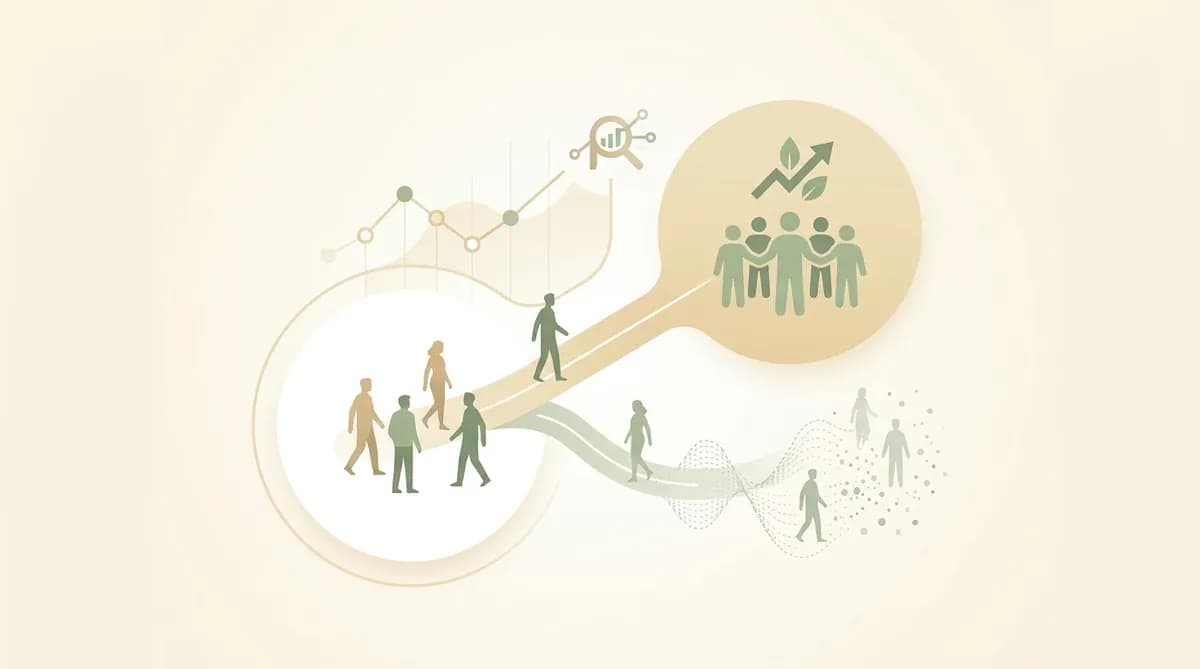
Some organizations are moving past the exit-or-stay binary entirely. Instead of scheduled interviews at fixed points, they run ongoing, adaptive conversations — short individual exchanges that happen regularly, adjust their questions based on previous responses, and aggregate patterns across the entire workforce.
The difference is structural, not cosmetic:
- Candor improves when conversations are confidential and not mediated by a direct manager. Employees say things to an independent channel that they would never say in a face-to-face stay interview.
- Languages stop being a barrier. A traditional stay interview program in a multinational company requires interviewers fluent in every local language. Adaptive conversations can operate natively in 40+ languages without translation layers.
- Patterns emerge early. When thousands of employees across dozens of locations are having regular conversations, you can detect a retention risk cluster in a specific team or region months before resignations begin.
A global retailer with 90,000+ employees across 40+ countries tested this approach. Their traditional engagement surveys had completion rates typical of the industry — low single digits in frontline roles. When they shifted to individual adaptive conversations, completion rates multiplied by four. More importantly, the qualitative depth of responses gave HR teams actionable signals they had never seen in survey data: specific management behaviors, site-level frustrations, and emerging skills gaps.
When to Use Each Approach
The exit interview vs stay interview question does have a practical answer — use both, but understand their limits.
| Approach | Best for | Limitation |
|---|---|---|
| Exit interview | Understanding departure patterns over time | Too late to retain the individual |
| Stay interview | Building manager-employee trust | Hard to scale, manager-dependent |
| Continuous adaptive conversations | Early detection, workforce-wide insights | Requires infrastructure and commitment |
Exit interviews still have value as a data source for systemic analysis. Stay interviews still build relationships when done well. But if your retention strategy depends on either one alone, you are building on incomplete data.
The organizations that reduce unwanted attrition are the ones listening continuously — not just at the bookends of an employee's tenure.
Moving Beyond the Binary
The exit interview vs stay interview debate frames retention as a reactive problem. Wait for someone to leave, then ask why. Or ask before they leave, and hope you asked at the right time.
Neither approach addresses the fundamental gap: most employees disengage gradually, over weeks and months, and the signals are there long before the resignation. The question is whether anyone is listening.
Some organizations are already making this shift — from episodic interviews to ongoing conversations that surface what matters, when it matters. Discover how.