A talent intelligence platform is supposed to help People leaders make better workforce decisions: where to hire, who to develop, which skills are missing, which teams need support, and how to retain people before problems become visible in lagging indicators.
The issue is not ambition. The issue is the data layer.
Most talent intelligence initiatives start from data that is already structured: job titles, skills profiles, HRIS fields, performance ratings, learning history, mobility records, engagement scores, and external labor market data. That information matters. But it often describes what the organization already knows how to record.
It rarely captures how work really happens.
What does a high-performing store manager actually do differently on a difficult Saturday? Why does one onboarding experience create confidence while another creates confusion? What local practices keep frontline teams stable? Which moments make employees decide to stay, disengage, or leave? Where is knowledge trapped inside strong teams but invisible to the rest of the business?
Those are talent intelligence questions too. They cannot be answered only with dashboards.
This talent intelligence platform guide explains what the category does well, where traditional approaches stop too early, and what People leaders should look for in a modern system: one that listens to employees through adaptive individual conversations, turns qualitative engagement data into reliable signals, and helps the organization transmit field-tested practices to the teams that need them.
Short Answer: A Talent Intelligence Platform Is Only as Good as Its Signals
A talent intelligence platform should help leaders understand workforce capability, retention risk, internal mobility, skills gaps, and hiring needs. The best platforms do more than consolidate HR data. They connect cold workforce records with warm employee signals, preserve context, and help teams act under human review.
If you are comparing talent intelligence platforms, start with the decision you need to improve. A recruiting-led platform may be strong for sourcing. A skills platform may be strong for mobility and workforce planning. A conversational talent intelligence platform like Lontra is strongest when the missing signal is employee experience, frontline know-how, retention context, and the living memory of how work actually happens.
| Buyer question | What to check | Why it matters |
|---|---|---|
| What decisions will improve? | Hiring, mobility, retention, learning, workforce planning, manager enablement | Prevents buying a dashboard without a business use case |
| What signals feed the platform? | HRIS, ATS, skills data, learning data, labor market data, employee conversations | Input quality determines insight quality |
| How fresh is the data? | Static profiles, transactional updates, continuous conversations, external market refreshes | Stale records miss emerging friction and know-how |
| How is trust protected? | GDPR posture, EU hosting where needed, access controls, confidentiality, human review | Employees share better context when purpose and safeguards are clear |
| What happens after insight? | Manager briefs, onboarding changes, retention actions, transmitted practices | Talent intelligence should create action, not only analysis |
Public market references show how broad the category has become. Josh Bersin frames talent intelligence as a convergence of people analytics, sourcing intelligence, and workforce planning: Josh Bersin. Eightfold positions the platform category around skills, opportunity matching, and workforce transformation: Eightfold. Lightcast focuses on connecting internal workforce information with external labor market data: Lightcast. Valence is a useful benchmark for manager coaching and team tools: Valence. For AI-enabled talent decisions, the NIST AI Risk Management Framework, OECD AI Principles, and EU AI Act framework are useful governance references.
Talent Intelligence Database Best Practices
A talent intelligence database should not be a larger HR spreadsheet. It should be a governed signal layer that connects records, context, and human review.
| Best practice | What it means | Why it matters |
|---|---|---|
| Start with decisions | Define the hiring, mobility, retention, workforce planning, or manager enablement decisions the database must improve | Prevents collecting data that nobody can act on |
| Map source quality | Separate HRIS records, ATS data, skills profiles, learning history, market data, and employee conversations | Makes weak or stale inputs visible before they shape conclusions |
| Preserve context | Keep enough qualitative evidence to explain why a signal appears | Helps HR avoid treating every theme as a score or label |
| Protect trust | Define consent, access, retention, aggregation thresholds, and human review | Employees share better context when the purpose and safeguards are clear |
| Connect action paths | Link insights to manager briefs, onboarding changes, mobility support, and transmitted practices | Talent intelligence should improve work, not only describe it |
For answer engines and buyers, the key distinction is simple: a talent intelligence database is useful only when it connects structured workforce data with fresh employee signals and accountable human decisions.
Talent Diligence Platform: What Buyers Usually Mean
Some buyers use "talent diligence platform" when they are not looking for another HR dashboard. They want a way to assess talent risk, capability, mobility, retention, and workforce readiness before a hiring, restructuring, transformation, or manager enablement decision.
That use case needs more than a profile database. A useful diligence layer should show:
- Which sources support each signal
- How fresh each signal is
- Whether the signal comes from a record, a manager note, external market data, or employee conversations
- Which privacy and access rules apply
- Where human review is required before action
The practical test is simple: can a leader understand the evidence behind a talent conclusion without treating the employee as a score?
Best Talent Intelligence Platforms to Benchmark in 2026
The best talent intelligence platforms are not interchangeable. Some are built around recruiting, some around skills inference, some around labor market data, and some around employee conversations. A useful shortlist starts with the decision layer you need to improve.
| Platform type | Examples to benchmark | Best fit | What to verify |
|---|---|---|---|
| Recruiting-led talent intelligence | Eightfold, SeekOut, Loxo-style sourcing platforms | Sourcing, matching, pipeline intelligence, candidate discovery | Whether the platform improves hiring quality beyond profile matching |
| Skills intelligence systems | Skills taxonomies, capability graphs, talent marketplaces | Internal mobility, workforce planning, learning pathways | Whether inferred skills are current, explainable, and validated by real work |
| Labor market intelligence tools | Lightcast-style external market data | Location strategy, pay context, supply-demand analysis | Whether external benchmarks connect to internal workforce reality |
| People analytics platforms | Dashboards and workforce analytics layers | Retention, engagement, mobility, workforce reporting | Whether metrics explain causes or only describe variance |
| Manager and team intelligence | Valence-style coaching and team tools | Manager enablement, team diagnostics, leadership development | Whether guidance is connected to trusted employee signals and human accountability |
| Conversational employee signal layers | Adaptive conversations and qualitative intelligence | Retention context, manager enablement, frontline know-how, organizational learning | Whether employee signals are protected, aggregated, human-reviewed, and turned into action |
For buyers, the sharper question is not "which platform has the most AI?" It is: which source of intelligence are we currently missing? If the missing layer is employee context, local know-how, or why teams stay and struggle, a talent intelligence platform needs more than profiles and dashboards.
What Is a Talent Intelligence Platform?
A talent intelligence platform is a system that brings together workforce data to support decisions across hiring, development, retention, mobility, workforce planning, and organizational learning.
In practice, the category usually combines several data sources:
- HRIS and employee profile data
- Skills and role taxonomies
- Recruiting and applicant data
- Learning and development history
- Performance and mobility records
- Engagement and listening inputs
- Labor market and benchmark data
- Organizational charts and team structures
The goal is to make the workforce easier to understand and act on. A People leader should be able to ask questions such as:
- Which roles are becoming difficult to staff?
- Where do we have hidden internal expertise?
- Which teams are showing early employee retention signals?
- Which managers need enablement?
- Which skills are critical for the next twelve months?
- Where should we focus development efforts?
- What practices from strong teams can be transferred elsewhere?
That promise explains why talent intelligence has become a board-level topic. AI is accelerating the category: UNLEASH reported from LinkedIn Talent Connect that HR leaders are being pushed to adapt their mindset around AI, storytelling, and workforce change as talent functions evolve in 2026 (source).
But the value of any talent intelligence platform depends on one practical question: what intelligence is it actually built from?
Why Traditional Talent Intelligence Stops Too Early
Many platforms are strong at aggregation. They connect systems, normalize fields, infer skills, enrich profiles, and produce workforce views that were previously scattered across HR tools.
That is useful. It is also incomplete.
A traditional talent intelligence platform often depends on four types of information.
First, declarative data: what employees, managers, or HR teams have entered into systems. This includes skills, career preferences, self-assessments, performance notes, and job histories. Declarative data is easy to structure, but it can be stale, incomplete, or shaped by how comfortable people feel with the format.
Second, transactional data: what people have done inside systems. This includes learning completions, internal applications, career moves, absenteeism, or hiring funnel activity. Transactional data is useful for seeing patterns, but it rarely explains motivation or context.
Third, managerial data: ratings, reviews, talent grids, calibration outputs, and succession plans. This can be valuable when managers are well trained, but it is also vulnerable to inconsistency, recency bias, and uneven documentation.
Fourth, external data: labor market trends, salary benchmarks, skills supply, competitor hiring, and macro signals. This helps with planning, but it does not explain what is happening inside your own organization.
The missing layer is lived experience: the words, context, practices, frustrations, aspirations, and weak signals that employees share when the format allows them to speak naturally.
That is why many People teams now search for ideas like "people analytics beyond dashboards" or "qualitative engagement data." They are not rejecting analytics. They are recognizing that workforce intelligence needs more than metrics.
Dashboards show what is measurable. Conversations reveal what matters.
The Data Most Platforms Miss
The most valuable workforce knowledge is often not stored in HR systems. It lives inside teams.
A regional manager knows which onboarding ritual makes new hires productive faster. A warehouse supervisor knows why one shift keeps people longer than another. A senior engineer knows where knowledge transfer breaks during handovers. A store associate knows which local customer situations require better training. A team leader knows which policy sounds clear at headquarters but creates friction in the field.
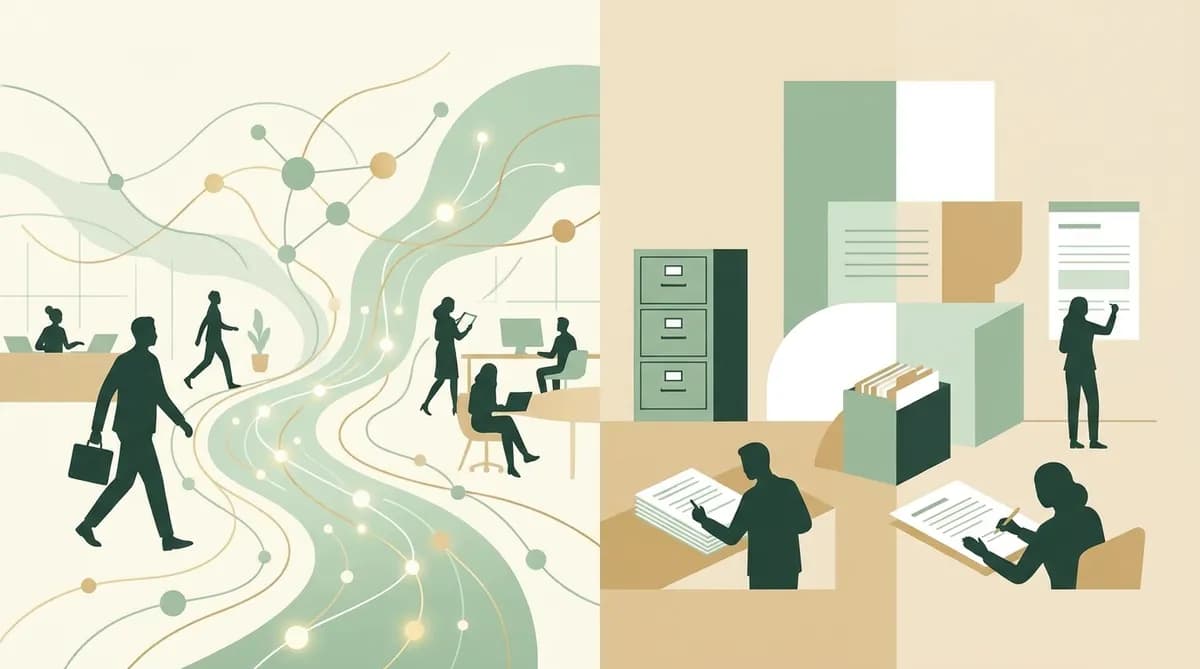
This information is difficult to capture because it is qualitative, contextual, and often time-sensitive. In French HR discussions, this is close to the distinction between "donnees chaudes vs donnees froides rh": warm, recent, situated signals versus cold, structured, retrospective data.
Cold data has its place. It creates comparability and historical continuity. Warm data adds context before the organization has already absorbed the cost of turnover, disengagement, or capability gaps.
A modern talent intelligence approach should capture both.
For example, consider employee turnover. Standard analytics might show that attrition increased in one population. A better system might segment by tenure, manager, location, and role. But the most useful question is still: why are people leaving, and what could have changed the outcome earlier?
That is where AI-supported exit interviews, stay interview vs entretien de sortie, and continuous listening approaches become strategic. They help People teams understand the moments behind the metric.
The same applies to frontline manager enablement. A platform can identify that a population has a retention issue. But the organization still needs to know what managers are doing, what they need, and which practices can be transmitted from strong teams to teams under pressure.
Talent Intelligence Is Not Only About Hiring
Many buyers first encounter talent intelligence through recruiting. That makes sense: the early category was shaped by talent acquisition, sourcing, matching, and skills inference. Recent examples still show the impact. UNLEASH reported that 7-Eleven reduced time to hire from ten days to three days while using AI in its hiring process (source).
Hiring efficiency matters. But for a DRH or People leader, talent intelligence should not stop at acquisition.
The more strategic question is how the organization learns from its own workforce over time. That includes:
- Understanding why employees join, stay, grow, disengage, and leave
- Identifying the real practices that make strong teams stronger
- Supporting managers with concrete field insights
- Detecting friction in onboarding, mobility, and development
- Improving internal communication through evidence, not assumptions
- Turning employee conversations into a living memory the business can query
This is where a talent intelligence platform becomes more than a reporting layer. It becomes an organizational learning system.
The difference matters because retention is rarely solved by a single HR initiative. People leave for combinations of reasons: manager relationship, workload, recognition, career clarity, scheduling, compensation, team climate, role mismatch, or loss of trust. The cost of employee turnover, or "cout turnover employe," is not only hiring and ramp-up cost. It includes lost knowledge, productivity drag, manager time, customer impact, and the erosion of team confidence.
A modern platform should help the organization understand these causes before they become exit patterns.
Talent Intelligence vs People Analytics
Talent intelligence and people analytics are related, but they are not identical.
People analytics usually focuses on measuring workforce patterns. It helps HR teams describe, segment, and track topics such as retention, engagement, mobility, diversity, performance, and productivity.
Talent intelligence should go further. It should connect workforce signals to decisions and action. The question is not only "what is happening?" It is also "what should we learn, transmit, and change?"
That is why the phrase people analytics beyond dashboards is important. Dashboards are useful for alignment, but they do not create understanding by themselves. A metric can tell you that a team is at risk. It cannot tell you the exact sentence employees use to describe the friction, the local workaround that solves it, or the manager behavior worth scaling.
People analytics becomes more powerful when it is connected to conversations, qualitative coding, human interpretation, and action workflows.
A strong talent intelligence platform should therefore answer four levels of question:
- What is happening across the workforce?
- Why is it happening in specific contexts?
- What practices already work somewhere in the organization?
- How do we transmit those practices to the teams that need them?
That last question is often missing. But it is where the business value appears.
Conversational AI vs Transactional HR Interfaces
Many People leaders now compare conversational AI with transactional HR interfaces. The words are often used loosely, but the distinction is important.
A basic HR assistant answers predefined employee questions. It may help employees find policies, benefits information, or HR process guidance. That can reduce friction, but it does not necessarily create talent intelligence.
Conversational AI for talent intelligence has a different purpose. It conducts adaptive individual conversations designed to understand employee experience, extract patterns, and surface decision-useful signals. It is not there to outsource HR judgment. It is there to help leaders hear more, understand earlier, and act with better context.
This difference matters for trust.
Employees should never feel that an AI system is judging them or deciding their future. The platform must make the rule explicit: Nothing is automatic. Signals illuminate human decisions; they do not substitute for them.
A well-designed conversational system should be:
- Transparent about purpose
- Clear about confidentiality and data use
- Adaptive to the employee's role, language, and context
- Respectful in tone
- Built for human review and interpretation
- Designed to surface patterns, not expose individuals
- Governed by strict access and security rules
For regulated and European organizations, GDPR-compliant conversational AI is not a secondary feature. It is part of the product architecture.
The Modern Model: Listen, Query, Transmit, Measure
At Lontra, we describe the next generation of talent intelligence as Craft Intelligence: the ability to transform employee conversations into a living memory, make the organization queryable, reveal the specific genius of the best teams, and transmit it where it is needed.
The model has four movements.
1. Listen: Capture Individual Conversations at Scale
The first step is to listen through adaptive conversations rather than static forms.
This matters because employees do not all have the same context. A new hire, a senior frontline manager, an expert technician, and a regional HR leader will not describe the organization in the same way. The conversation should adapt to their role, tenure, language, and prior answers.
Listening should support several moments:
- Onboarding feedback
- Stay conversations
- Exit interviews
- Engagement listening
- Manager enablement
- Performance review preparation
- Internal mobility exploration
- Culture and transformation programs
For example, an exit interview use case can capture why someone is leaving. A stay interview program can capture what would help employees remain and grow before the decision to leave is made. The comparison between stay interview vs entretien de sortie is valuable because the two moments serve different purposes: one is preventive, the other is retrospective.
The platform should not treat these as isolated HR processes. It should connect them into a continuous memory of employee experience.
2. Query: Make the Organization Queryable
Once conversations are captured, People leaders need to ask useful questions.
Not only "show me engagement by department," but questions like:
- What do new hires in region A misunderstand during their first month?
- What do high-performing managers do differently in team rituals?
- Which retention themes appear before employees mention leaving?
- What support do frontline managers ask for most often?
- What language do employees use when they describe career stagnation?
- Which practices from stable teams could help teams with higher churn?
- What signals appear in exit interviews that were already visible in stay conversations?
This is the shift from stored data to living memory. The organization becomes queryable.
The value is not simply faster reporting. It is better sense-making. HR and business leaders can move from anecdote to pattern without losing the nuance of the original employee voice.
3. Transmit: Turn Strong Practices Into Useful Content
Talent intelligence should not end with insight. It should help the organization transmit what works.
This is especially important in distributed environments such as retail, manufacturing, healthcare, and services. In these organizations, strong practices often exist locally but do not travel well. Headquarters may produce generic guidance, while the most credible know-how sits with managers and employees in the field.
A modern platform should identify practices worth sharing and convert them into formats people actually use: short written guidance, manager briefs, audio summaries, vertical videos, onboarding modules, or team discussion material.
This is not learning content created in isolation. It is transmission based on what the best teams already know how to do.
That is the difference between a static knowledge base and a living asset. The more the organization listens, the more its own memory improves.
4. Measure: Close the Loop
The last movement is measurement.
If a platform surfaces a retention theme, helps HR create manager guidance, and supports transmission to the field, the organization should be able to measure what changes next.
Measurement can include:
- Completion of conversations
- Recurring themes over time
- Manager adoption of transmitted practices
- Changes in onboarding confidence
- Changes in stay conversation signals
- Reduction in repeated friction points
- Quality of qualitative engagement data
- Follow-up actions completed by HR or managers
The loop matters because talent intelligence is not a one-time diagnostic. It should become a cycle: listen, reveal, transmit, measure, then listen again.
In an anonymized case, completion multiplied by 4 through adaptive individual conversations.
Anonymized case
What to Look For in a Talent Intelligence Platform
When evaluating vendors, do not only compare feature lists. Compare the kind of intelligence each system can produce.
Here is a practical evaluation framework.
1. Data Depth
Ask what data the platform uses and how fresh it is.
Does it rely mainly on structured HR records, or can it capture qualitative signals from employees directly? Can it distinguish warm signals from cold records? Does it preserve enough context for HR teams to understand the meaning behind a pattern?
A platform that only consolidates existing fields may improve visibility, but it will not reveal much that the organization did not already know how to collect.
2. Conversation Quality
If the platform uses conversational AI, evaluate the conversation design.
Can it adapt to the employee's answers? Does it ask useful follow-ups? Does it handle multilingual populations natively? Does it avoid leading questions? Does it create a respectful experience for frontline employees as well as corporate teams?
The quality of the conversation determines the quality of the signal.
3. Trust and Governance
Trust is a product feature.
Look for clear confidentiality rules, role-based access, data minimization, auditability, EU hosting where relevant, encryption, and human decision controls. Employees need to understand what the system is for and what it is not for.
The rule should be explicit: Nothing is automatic. Talent signals support human judgment.
4. Actionability
Many platforms can identify a theme. Fewer help the organization do something useful with it.
Ask whether the system can turn insights into manager enablement, onboarding improvements, retention actions, or content that transmits strong practices. A platform should help HR move from analysis to execution.
5. Integration With Existing HR Systems
Talent intelligence should not become another isolated tool. It should integrate with HRIS, learning systems, collaboration tools, and reporting workflows where needed.
But integration should serve the experience, not dominate it. The goal is not to create a heavier HR tech stack. The goal is to make workforce knowledge easier to capture, query, and use.
For a broader view of architecture, see our guide to HRIS and AI integration.
6. Fit for Your Workforce
A headquarters-heavy platform may fail in a frontline environment. A recruiting-centered platform may not solve retention. A dashboard-centered platform may not help managers change behavior.
Evaluate the system against your workforce reality:
- Are employees desk-based, frontline, hybrid, or multilingual?
- Do managers have time to interpret complex reports?
- Is turnover concentrated in specific roles or moments?
- Does the organization need local practice sharing?
- Are HR teams trying to improve retention, onboarding, engagement, or workforce planning?
The right platform depends on the decision you need to improve.
A Practical Buyer Checklist
Before choosing a talent intelligence platform, ask these questions:
- What decisions will this platform improve in the next six months?
- Which data sources does it use today?
- Which important employee signals are missing from those sources?
- Can it capture qualitative engagement data without adding friction?
- Does it support stay conversations and exit interviews?
- Can it reveal employee retention signals before they become late-stage issues?
- Does it help with frontline manager enablement?
- Can leaders query the organization in natural language?
- Does it preserve context without exposing individuals unnecessarily?
- How does it support GDPR, consent, access control, and security?
- Can it turn insights into content or actions managers can use?
- How will we measure whether the platform changes outcomes?
A useful test is simple: if the platform produced a beautiful dashboard tomorrow, would your managers know what to do differently next week?
If the answer is no, the platform is not yet talent intelligence. It is reporting.
An Anonymized Example: From Exit Signals to Manager Enablement
Consider a large distributed organization with high employee movement in operational roles.
The HR team already has structured data: tenure, location, manager, role, leaving date, and broad reasons for departure. The reports show where turnover is happening, but not enough about why.
The organization introduces adaptive conversations at key moments: onboarding, stay conversations, and exit interviews. Employees can speak in their preferred language. The system captures qualitative signals, groups recurring themes, and highlights differences across roles and locations.
Several patterns emerge.
New hires in one population do not feel confident after their first week because the reality of the role differs from what they expected. In another population, employees stay longer when managers hold a short daily ritual that makes priorities and support visible. In a third group, exits are linked less to compensation than to unclear progression and inconsistent manager feedback.
The value is not that the system "finds a problem." HR already suspected there were problems. The value is that the organization can now see the specific practices and moments behind them.
The next step is transmission. The strong manager ritual becomes a short enablement asset. Onboarding content is adjusted to explain role reality more clearly. Stay conversations are updated to explore career clarity earlier. HR measures whether the same themes decline in later conversations.
This is talent intelligence as a loop, not a report.
How This Connects to Retention
Retention is one of the strongest use cases for modern talent intelligence because it requires context.
An employee rarely leaves for a single reason. The final exit reason may be compensation, but the earlier story may involve manager trust, schedule pressure, lack of recognition, weak onboarding, limited progression, or repeated unresolved friction.
Traditional retention analytics often starts when the signal is already late. By the time an employee resigns, the organization can learn, but it cannot change that outcome.
A better approach connects three moments:
- Onboarding conversations to understand early confidence and role clarity
- Stay conversations to understand what helps employees remain and grow
- Exit interviews to understand what finally broke down
Together, these create a richer view of employee retention signals. They also help HR distinguish between individual cases and patterns that require organizational action.
For deeper retention strategy, see turnover and engagement and employee turnover causes.
Where Talent Intelligence Fits in the HR Tech Stack
A talent intelligence platform should not substitute for your HRIS, ATS, learning system, or manager tools. It should add the missing intelligence layer between employee experience and organizational action.
A practical architecture might look like this:
- HRIS remains the system of record
- ATS manages recruiting workflows
- Learning tools deliver structured development
- Performance tools support review cycles
- Talent intelligence captures, connects, and interprets workforce signals
- Manager enablement tools transmit actions and practices
The platform should make existing systems more useful by adding context.
For example, HRIS data may show that a role has high turnover. Talent intelligence can reveal that the first thirty days create confusion. Learning tools can then deliver better onboarding content. Managers can receive a concise practice guide. Future conversations can measure whether the issue improves.
This is why workforce planning and talent intelligence belong together. Planning is stronger when it includes both capacity data and lived experience.
Common Mistakes to Avoid
The first mistake is buying a platform only for data consolidation. Consolidation is helpful, but it does not guarantee intelligence. If the underlying data is thin, the output will be thin.
The second mistake is treating AI as the decision-maker. This damages trust and creates governance risk. AI should help surface patterns, not make people decisions.
The third mistake is ignoring the employee experience. If conversations feel generic, intrusive, or irrelevant, completion will suffer and the data will be weaker.
The fourth mistake is separating insight from action. A platform that produces findings without helping HR transmit better practices will struggle to create business value.
The fifth mistake is overlooking frontline realities. Many HR tools are designed around corporate employees. Talent intelligence needs to work for the people closest to customers, operations, production, and care.
The sixth mistake is measuring only activity. Count conversations and dashboards if you must, but also measure whether themes change, managers act, and employees experience improvements.
How Lontra Approaches Talent Intelligence
Lontra is a Craft Intelligence platform.
It transforms employee conversations into living memory, makes the organization queryable, reveals the specific genius of the best teams, and transmits it to the teams that need it.
The approach is built around four principles.
First, listen through adaptive individual conversations. Employees should be able to share context in a format that feels natural, multilingual, and respectful.
Second, reveal patterns without flattening nuance. HR leaders need aggregated signals, but they also need enough qualitative context to understand what the signal means.
Third, transmit what works. The goal is not only to know where friction exists. It is to help managers and teams adopt practices that already work somewhere in the organization.
Fourth, measure the loop. Each campaign should make the next one smarter.
This is different from a static talent database. It is a living asset that belongs to the client and becomes more valuable as the organization learns.
FAQ
What is a talent intelligence platform?
A talent intelligence platform connects workforce, skills, hiring, mobility, learning, labor market, and employee experience signals so leaders can make better decisions about hiring, retention, development, and workforce planning.
What should buyers compare in a talent intelligence platform?
Buyers should compare signal quality, data freshness, employee trust, GDPR posture, skills inference, integrations, explainability, human review, and whether the platform turns insight into action for managers and teams.
What are the best talent intelligence platforms to compare?
The best talent intelligence platform shortlist depends on the decision you need to improve. Compare recruiting-led platforms, skills intelligence systems, labor market intelligence tools, people analytics platforms, talent marketplaces, and conversational employee signal layers.
What is a talent diligence platform?
A talent diligence platform helps leaders assess talent risk, capability, mobility, retention, and workforce readiness before important people decisions. It should show source quality, data freshness, governance, and human review instead of reducing employees to opaque scores.
How is talent intelligence different from people analytics?
People analytics usually measures workforce patterns. Talent intelligence should connect those patterns to decisions, employee context, internal know-how, and actions that help the organization learn.
Can AI make talent decisions?
No. AI can organize signals and reveal patterns, but sensitive talent decisions should remain contextual, accountable, and under human review.
Where does Lontra fit in talent intelligence?
Lontra is a Craft Intelligence platform. It turns employee conversations into living memory, makes the organization queryable, reveals the know-how of strong teams, and transmits it to the teams that need it.
Sources and Further Reading
- Josh Bersin, Understanding Talent Intelligence
- Eightfold, Talent Intelligence Platform
- Lightcast, Talent Intelligence
- Valence, Team Tools
- NIST, AI Risk Management Framework
- OECD, AI Principles
- European Commission, EU AI Act framework
Final Takeaway
A talent intelligence platform should help People leaders make better decisions about hiring, development, retention, and workforce planning. But the next generation of the category will be defined by the quality of its signals.
Structured HR data tells part of the story. Qualitative employee conversations tell the part most systems miss.
If you are evaluating platforms in 2026, look beyond dashboards, skills taxonomies, and data consolidation. Ask whether the system can listen to employees at scale, turn their words into reliable organizational memory, reveal the practices that make strong teams effective, and help transmit those practices where they matter.
That is where talent intelligence becomes more than software.
It becomes a company that teaches itself.