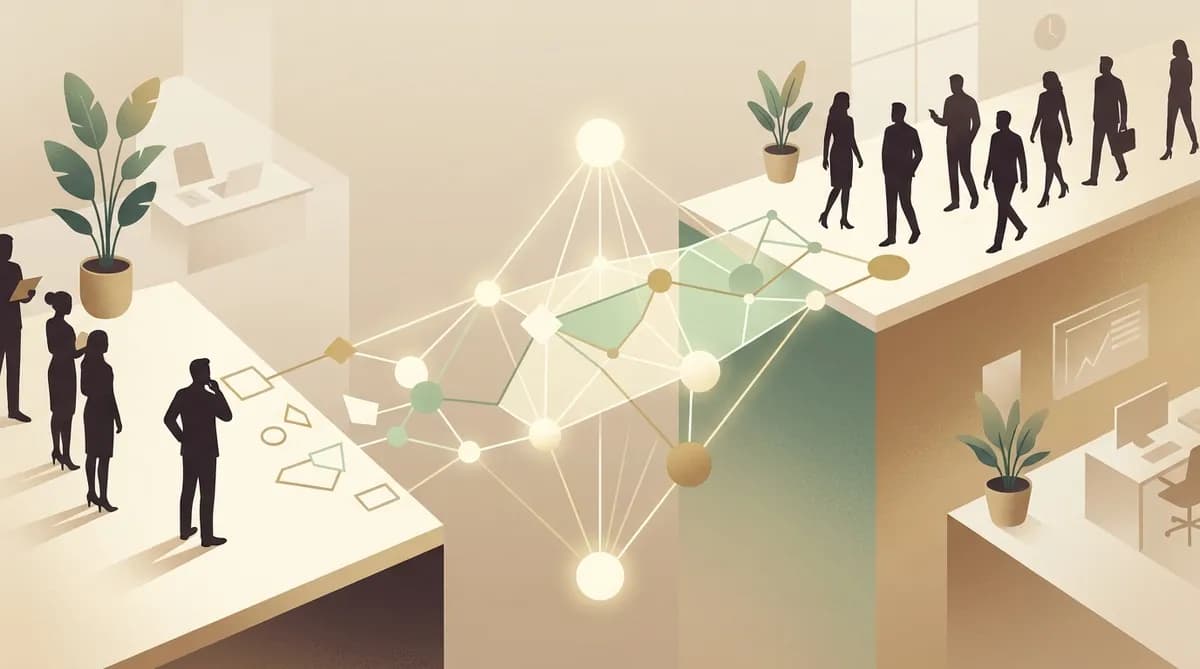
Your CEO asks a direct question: "Can we staff the new operating model with people we already have?"
HR opens the HRIS, the learning platform, the performance review archive, the succession grid, the spreadsheet owned by one business unit, and a set of manager notes that were never meant to travel. The answer should be available in minutes. Instead, the organization has fragments: job titles, declared skills, course completions, manager ratings, and a few names everyone already knows.
That is the daily problem employee skills mapping is supposed to solve. Not as a static inventory, but as a way to understand what people can do, what they want to learn, where expertise already exists, and which capabilities the business will need next.
What is employee skills mapping?
Employee skills mapping is the practice of identifying, structuring, and updating the skills, proficiency levels, experiences, and working preferences that exist across a workforce. A useful skills map connects people to roles, projects, locations, languages, certifications, tacit know-how, and future business needs, so leaders can make workforce decisions from evidence rather than memory.
Most ranking guides explain the basics well. AIHR frames skills mapping as identifying, assessing, and documenting employee abilities. Gloat emphasizes the link between employee skills and role requirements. TalentGuard focuses on searchable software and skills matrices. Voxy adds a practical implementation angle, including templates and assessment rollouts.
The gap is not definition. The gap is freshness.
A skills map that depends on annual self-assessment is already aging when it is completed. A skills map that only imports CVs misses what people learned on the job. A skills map that relies on manager judgment tends to overrepresent visible performers and underrepresent quiet expertise. A skills map that tracks only formal learning knows what people consumed, not what they can transmit to others.
Why traditional skills mapping breaks down
The World Economic Forum's Future of Jobs Report 2025 gathered input from over 1,000 global employers representing more than 14 million workers. It estimates that 39% of workers' existing skill sets will be transformed or become outdated between 2025 and 2030. It also reports that 63% of employers see skills gaps as a major barrier to business transformation.
That does not mean every organization needs a larger spreadsheet. It means the rhythm of skills intelligence has to change.
Traditional approaches usually fail for four reasons.
First, standardized forms flatten context. An employee may rate herself as "advanced" in stakeholder management, but that label does not tell you whether she can calm a tense works council meeting, align store managers across countries, or translate a technical roadmap into language frontline teams trust.
Second, periodic campaigns create cold data. A skills survey captures what someone declared at one moment. It rarely captures what happened after a difficult launch, a regional expansion, a new manager, a customer escalation, or a cross-functional project.
Third, one-off manager interviews reinforce hierarchy. Managers see part of the work. They do not always see peer coaching, informal problem solving, multilingual mediation, customer intuition, or the craft routines that make the best teams reliable.
Fourth, most systems map skills as nouns. The business needs verbs. Not "communication". "Explains a new process to a skeptical team without losing momentum." Not "data literacy". "Challenges a dashboard when the underlying sample is too weak." Not "leadership". "Gets a store team through peak season without burnout."
The better approach: live skills intelligence
There is another way to build employee skills mapping: start from adaptive individual conversations, not forms.
A conversation can ask an employee what they actually do when the work becomes hard. It can follow up when an answer is vague. It can distinguish claimed ability from concrete evidence. It can capture examples, context, confidence, constraints, and appetite for growth. It can ask the same strategic question in the employee's preferred language and still preserve a shared structure for analysis.
This is where Craft Intelligence matters.
A Craft Intelligence platform turns employee conversations into living memory. It does not treat employees as rows in a skills table. It listens for the craft of the work: the routines, judgment calls, local adaptations, informal expertise, and field-tested methods that make performance possible. It then makes the organization queryable, so HR and leaders can ask better questions:
- Which teams already know how to onboard seasonal employees quickly?
- Where do we have multilingual managers who can support a new country launch?
- Which frontline supervisors are strong at conflict de-escalation?
- What skills are emerging in high-performing teams before they appear in job descriptions?
- Which capabilities are missing for next year's workforce plan?
This does not remove human judgment. Signals should inform decisions; they should not make them. The role of the system is to reveal patterns leaders could not see at scale, then give HR enough context to act responsibly.
Employee skills mapping vs talent mapping
Employee skills mapping focuses on what people can do now, how strongly they can do it, and where those capabilities sit across the organization. Talent mapping is broader: it connects skills, potential, mobility, succession, readiness, motivation, and business demand. Skills mapping is one of the data foundations that makes talent mapping credible.
That distinction matters because many companies jump too quickly to succession or internal mobility without understanding the raw capability base. If the underlying skills map is stale, the talent map becomes a polished view of old assumptions.
For a broader view of how skills connect to capacity, hiring, and operating plans, read the pillar guide on workforce planning.
What should a modern skills map include?
A useful employee skills map should contain more than skill labels. At minimum, it should capture seven layers.
1. Core skills by role
These are the capabilities required to perform in a role today. They should be linked to role architecture, not copied blindly from generic taxonomies. A retail store manager, manufacturing shift lead, enterprise account executive, and care coordinator may all need "coaching", but the observable behaviors are different.
2. Proficiency evidence
A rating is not enough. The map should include evidence: examples of where the skill was used, under what conditions, with what level of autonomy, and with what outcome. Evidence prevents false precision.
3. Tacit know-how
The most valuable skills are often hard to name. They appear in how experienced employees sequence work, manage exceptions, read customer behavior, or prevent recurring problems. This is the layer most forms miss.
4. Learning appetite
A person may have an adjacent skill and no desire to grow it. Another may have low proficiency but strong motivation. For workforce planning, willingness matters.
5. Transferability
Skills should be mapped across roles and contexts. A scheduling skill in healthcare may translate into resource planning in services. A negotiation skill in procurement may transfer to partner management.
6. Recency
A skill used five years ago is not the same as a skill practiced last month. Recency helps leaders separate dormant experience from active capability.
7. Confidence and constraints
People may have the skill but lack time, language comfort, location flexibility, manager support, or psychological permission to use it. A map that ignores constraints will overstate readiness.
How to implement employee skills mapping in 2026
Start with a business question, not a taxonomy. "Do we have enough managers for regional expansion?" is better than "Which skills should we list?" "Can we redeploy before hiring externally?" is better than "Can we fill every cell in the matrix?"
Then follow a disciplined sequence.
1. Define the decision the map must support
Choose one high-value use case: workforce planning, internal mobility, succession, capability building, post-merger integration, frontline performance, or skills-based hiring. If the map is meant to support every HR process at once, it will become too abstract.
Good decision questions include:
- Which roles are exposed to capability risk?
- Which teams can absorb new work without external hiring?
- Which skills should learning investment prioritize?
- Which internal candidates have adjacent experience for hard-to-fill roles?
- Which expert practices should be transmitted across teams?
2. Build a business-linked skills framework
Use external taxonomies as references, not as the operating truth. A skills framework should reflect your business model, customers, technology, regulatory context, and ways of working.
For each skill, define observable evidence. Replace "strategic thinking" with examples of what strategic thinking looks like in your context. Replace "customer orientation" with the behaviors that distinguish strong teams from average teams.
3. Capture live qualitative data
Use adaptive conversations to collect evidence from employees, managers, and expert teams. Ask for concrete moments: a difficult customer interaction, a project that nearly failed, a handover that worked, a process workaround, a skill someone learned informally.
This creates richer data than standardized self-ratings because it captures the story behind the label.
4. Structure the signal without erasing nuance
The goal is not to store transcripts forever and call it intelligence. The goal is to transform conversations into structured, queryable signals while keeping enough context for human review.
For example, a conversation may reveal "inventory planning", "conflict de-escalation", and "peer coaching". The system should attach evidence, confidence, recency, and source context. HR should be able to inspect why a signal exists.
5. Compare current capability with future demand
Connect the skills map to workforce planning. If the business is changing channels, opening new regions, deploying new tools, or redesigning roles, the skills map should show the distance between current capability and future need.
This is where employee skills mapping becomes strategic. It stops being an HR reporting exercise and becomes a way to decide whether to hire, train, redeploy, redesign work, or transmit expertise from stronger teams.
6. Turn expert practice into reusable knowledge
The best skills maps do not only identify gaps. They reveal internal craft.
If one region consistently performs better, do not stop at "they have stronger managers". Ask what those managers do differently. How do they brief teams? How do they handle objections? How do they onboard newcomers? How do they recover after a difficult week?
Once captured, that know-how can be transmitted through targeted formats: short video, audio, written playbooks, manager prompts, or onboarding sequences. The format should fit how employees actually learn.
7. Govern access and trust
Skills data can help people grow, but it can also create fear if employees believe it will be used to label or punish them. Be explicit about purpose, access, retention, and decision rights. In Europe, GDPR expectations are not a footnote; they shape adoption.
A trustworthy skills mapping program should explain what is collected, how it is used, who can see it, and how employees can challenge or contextualize it. The system should support human decisions, not hide them behind scores.
A concrete anonymized example
A large distributed organization wanted to understand why some local teams were adopting a new operating routine faster than others. The existing data showed completion of training modules and manager confirmations. It did not explain the difference in field performance.
Adaptive individual conversations revealed that the strongest teams had developed a specific onboarding habit. New joiners were not only trained on the process; they were paired with experienced colleagues who explained the exceptions: when to escalate, when to adapt the script, which customer signals mattered, and how to recover after a failed interaction.
That know-how was invisible in the skills matrix. It was not a formal competency. It was craft.
Once captured, the organization could query where this practice existed, which managers used it consistently, which teams lacked it, and what format would help transfer it. The skills map became more than a list of capabilities. It became a living memory of how good work actually happened.
In an anonymized case, completion multiplied by 4 by moving from declarative formats to adaptive individual conversations.
Anonymized case
What the market conversation is missing
Recent public discussions on X around LLMs and talent development, employee training, performance reviews, and employee engagement tools show a familiar tension. Leaders want more personalized development and less administrative burden, but they worry about losing human context.
That concern is justified.
The future of employee skills mapping is not a chatbot that asks people to update a profile. It is not a dashboard that ranks employees. It is not a quarterly form with cleaner charts.
The stronger path is conversational, governed, multilingual, and evidence-based. It captures what employees know, how they learned it, where it applies, and what the organization can do with it. It turns workforce knowledge into an asset the company can build on.
For the analytics layer behind this shift, see People Analytics Beyond Dashboards and Qualitative Engagement Data.
Employee skills mapping checklist
Use this checklist before choosing a tool or launching a campaign.
- Can leaders ask a business question and get a usable answer?
- Does the map include evidence, not only declared proficiency?
- Can employees explain skills in their own words and language?
- Does the system capture tacit know-how from high-performing teams?
- Are skills connected to future workforce demand?
- Can HR inspect the source context behind a signal?
- Are access rights, retention rules, and employee trust clearly governed?
- Does the map update through ongoing conversations, not only campaigns?
- Can the organization transmit discovered know-how to the teams that need it?
If the answer is no, the organization may have a skills database, but it does not yet have living workforce intelligence.
The point of employee skills mapping
Employee skills mapping is not about cataloging everyone perfectly. It is about helping the organization learn from itself.
The companies that get value from skills mapping will not be the ones with the largest taxonomy. They will be the ones that can hear what employees actually know, structure it responsibly, and use it to make better human decisions: where to grow, where to redeploy, where to hire, and where to transmit the craft of the best teams.
When the CEO asks, "Can we staff this with people we already have?", HR should not need weeks of manual reconciliation.
The organization should be queryable.