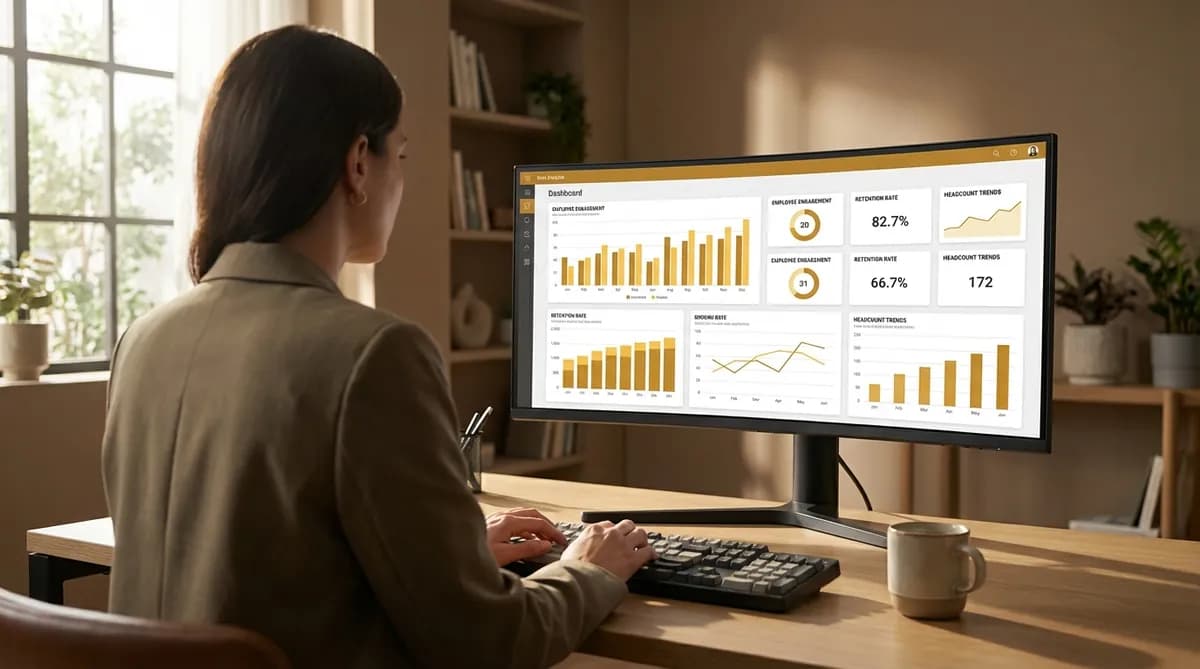
A CHRO does not wake up worried about a dashboard. The real problem is colder: a leadership team is about to decide where to invest, which managers need support, which teams are losing trust, and which locations are carrying operational knowledge that nobody else can see. The engagement campaign has closed. Participation is uneven. Comments are thin. The loudest teams are visible. The silent teams are interpreted.
That is the survey completion rates problem in HR: low completion does not only reduce sample size. It changes what the organization believes it knows.
When completion falls, HR often tries to fix the instrument. Shorter form. Cleaner wording. Better reminder. More mobile-friendly design. Those improvements matter, but they do not answer the deeper question: why would an employee give useful, specific, candid context to a format that rarely gives anything back?
What is the survey completion rates problem?
The survey completion rates problem is the gap between employees who start a feedback process and employees who finish it with usable information. In HR, the issue is not only abandonment. It is also weak signal: partial answers, rushed scores, generic comments, missing context, and silent populations that leaders still need to understand.
SurveyMonkey defines completion rate as completed submissions divided by people who entered the survey, while response rate is completed submissions divided by the invited sample. That distinction matters because a campaign can attract clicks and still fail once employees see what is being asked of them. SurveyMonkey makes the operational point clearly: completion rate measures interaction with the experience, not invitation reach.
Response rate answers: did people show up? Completion rate answers: did the experience hold their attention long enough to capture usable data? HR needs both, but completion is the sharper warning sign when employees begin the process and decide the effort is not worth finishing.
Why standard benchmarks mislead HR teams
Many articles about survey completion rates focus on benchmarks. They define the metric, compare completion and response rates, then list fixes: reduce length, improve branching, set expectations, optimize for mobile. Those are useful basics.
They are not enough for a CEO or CHRO trying to understand real employee engagement.
Pointerpro cites an average survey response rate of 33%, with email surveys averaging 30% and in-person surveys 57%. It also notes that internal employee surveys receive higher response rates than external surveys, and that response drops when surveys exceed 12 questions or take longer than 5 minutes. Those figures are helpful directional references, but they still sit inside a form-based view of the world: send, remind, complete, analyze. Pointerpro frames the classic optimization logic well.
Lensym makes another useful distinction: completion rate measures whether the experience respects respondent time. It also notes that drop-off clusters around friction points: early commitment, hard questions, long middle sections, and mobile pain. Lensym is right on experience design.
But HR leaders face a harder problem than form design. In an employee context, completion is affected by trust, relevance, timing, language, psychological effort, and the employee’s belief that the organization will do something intelligent with the answer.
A shorter form can raise completion and still miss the truth.
Completion rate is a data quality metric, not a vanity metric
A high completion rate is not proof that employee data is good. It only proves that people reached the end. The real question is whether the completed answers contain decision-grade context: what is happening, where, why now, who is affected, and what local knowledge could help another team.
This is where many engagement programs break. They optimize for completion while losing specificity. They ask employees to compress lived experience into scales. They invite comments at the end, when attention is lowest. They gather sentiment without craft: the practical know-how, workarounds, manager habits, local rituals, and operational frictions that explain performance.
If your completion rate improves but comments remain generic, you have not solved the employee engagement measurement problem. You have improved the container. The signal is still weak.
For a broader view of what to measure beyond participation, see our guide to measuring employee engagement in 2026.
Why employees abandon feedback forms
Employees rarely abandon forms because they are careless. They abandon them because the exchange feels poor.
The most common reasons are structural:
- The question does not fit the employee’s role, location, seniority, or recent experience.
- The employee has already answered similar questions before and never saw visible follow-up.
- The form asks for a score where the real answer is a story.
- Sensitive topics are introduced without enough trust.
- The experience feels designed for reporting, not listening.
- The employee is on mobile, between tasks, or outside a desk-based workflow.
- The language is technically correct but emotionally distant.
Completion is not only a UX issue. It is a relationship issue.
This is especially visible in frontline environments such as retail, manufacturing, healthcare, and services, where employees may not have protected time, corporate email habits, or confidence that head office understands daily work. The form asks for a pause. The workplace does not give one.
Why traditional fixes plateau
There are reasonable ways to improve survey completion rates: reduce length, make every question necessary, use branching, state the time required, send reminders, and remove repeated demographic questions. HR should do those things.
The plateau appears when the format itself becomes the constraint.
A standardized form must ask the same question to many people. That makes analysis easier, but it can make the exchange less relevant. A periodic campaign creates a snapshot, but employee reality changes between campaigns. A one-off manager interview can capture nuance, but it is hard to scale and inconsistent across teams.
The result is a familiar trade-off:
- Standardized forms scale but lose context.
- Interviews capture context but do not scale cleanly.
- Dashboards summarize patterns but rarely explain the work behind them.
- Manager conversations create insight but often stay trapped locally.
People analytics teams know this tension. The dashboard shows a drop in trust, engagement, or intent to stay. The executive committee asks why. HR can segment by country, function, tenure, and manager. But the real answer is usually qualitative: a change in scheduling, a broken onboarding habit, a promotion process nobody trusts, a local manager who protects learning time, a team that has found a better way to transmit know-how.
That is why people analytics beyond dashboards has become a practical priority. The next layer is not more charts. It is better input.
The 2026 context: HR needs live signal, not colder reporting
The pressure on HR teams is rising. HR Executive’s coverage of Deloitte’s 2026 Global Human Capital Trends report says one-third of workers surveyed experienced 15 major organizational changes in a single year. It also reports that 85% of leaders call continuous adaptability critical, while only 27% say their organizations manage change well. HR Executive frames the issue as a gap between what leaders need and what organizations have built.
That matters for completion rates because episodic listening cannot keep up with continuous change. By the time a quarterly or annual form closes, the context behind the answers may already have shifted.
The same HR Executive article reports a governance gap around technology at work: 60% of executives use AI in decision-making, but only 5% say they manage it well. For employee listening, the implication is direct. HR cannot respond to weak participation by adding opaque analysis on top of weak input. Trust, decision rights, and human accountability have to be designed into the process.
HR Dive’s March 2026 coverage of Littler Mendelson research adds another layer: regulatory and economic uncertainty led more than one-third of surveyed employers to reduce headcount, while 30% paused or reduced hiring. HR Dive also reports that state and local regulatory changes affected 9 in 10 respondents. In that environment, employee signal cannot be vague. Leaders need to know where pressure is accumulating before it becomes resignation, disengagement, or operational failure.
The alternative: adaptive individual conversations
There is another way to address the survey completion rates problem: replace the form-first mindset with adaptive individual conversations.
An adaptive conversation starts with a clear business question, then adjusts to the employee’s context. It can ask follow-ups when an answer is vague. It can move past irrelevant topics. It can capture examples, not only scores. It can operate across languages. It can turn qualitative input into structured signals without forcing employees to think like analysts.
The goal is not to make decisions on behalf of managers or HR. Nothing should remove human judgment from people decisions. The goal is to make the organization more queryable: to let leaders ask what is happening across teams, why a pattern is emerging, which practices work locally, and what knowledge should be transmitted elsewhere.
This is the Craft Intelligence approach. The organization does not only measure sentiment. It listens to work. It turns employee conversations into living memory. It reveals the specific know-how of the best teams and helps transmit it to the teams that need it.
That shift changes the completion conversation. Employees are more likely to finish when the exchange feels relevant. HR gets stronger signal because the format can ask the next useful question. Leaders get a living memory instead of another static export.
A concrete anonymized case
In a large, distributed workforce, HR had a familiar problem. Participation in traditional declarative formats was low and uneven. The employees closest to customers had the richest operational knowledge, but they were also the least likely to spend time on static forms. Leadership could see performance differences across teams, yet the reasons stayed local and informal.
The listening approach changed in three ways.
First, employees were invited into short adaptive conversations rather than a fixed form. The conversation adapted to the person’s role and language, then followed up on concrete moments: onboarding, manager support, customer pressure, scheduling, product knowledge, team rituals, and what helped new colleagues succeed.
Second, the output was not treated as a pile of comments. Signals were structured into themes that HR and business leaders could query. A leader could ask where onboarding was breaking down, which teams had found effective peer-learning routines, or what frontline employees needed before peak periods.
Third, the best local practices were not left as anecdotes. They became reusable knowledge for targeted transmission: short content, manager briefs, and team-specific material that helped one part of the organization learn from another.
Completion multiplied by 4 compared with the previous declarative format. More importantly, the quality of the input changed. Employees did not only say whether they were engaged. They explained what made work easier, harder, safer, clearer, or more teachable.
In an anonymized case, completion multiplied by 4 by moving from declarative formats to adaptive individual conversations.
Anonymized case
How to diagnose your own completion problem
Before changing tools or campaigns, diagnose the real failure mode. Low completion can mean several different things.
If many employees never start, your issue may be trust, timing, channel, or perceived relevance. If employees start and abandon early, the opening may not match expectations. If they leave in the middle, the cognitive effort may be too high. If they finish but give empty answers, the format may be suppressing useful context. If completion varies sharply by population, the listening experience may fit headquarters better than the field.
A practical diagnostic should include:
- Start rate by population, not only global response.
- Completion rate by device, location, language, tenure, and role.
- Drop-off point by question or section.
- Comment depth, not only comment volume.
- Repetition rate: how often employees give generic answers.
- Action traceability: whether leaders can connect input to decisions.
- Trust signals: whether sensitive topics produce silence or detail.
The last point matters most. A feedback process that avoids sensitive reality may look clean, but it will not help leaders act.
For exit contexts, this is even more visible. Employees often hold clear explanations for why they are leaving, but forms flatten those explanations into categories. Adaptive conversations are especially useful when the organization needs candid context after trust has already weakened.
How to improve completion without weakening signal
The aim is not to make feedback easier at any cost. It is to make the exchange worthy of the employee’s attention.
Use these principles:
-
Start from the decision, not the question list. Ask what leaders must decide after the listening cycle. Remove anything that will not change an action.
-
Personalize the path. A store employee, engineer, nurse, warehouse supervisor, and sales manager should not all receive the same sequence.
-
Ask for moments, not opinions only. “Tell us about a recent moment when onboarding worked or failed” will often produce more useful data than a generic rating.
-
Follow up intelligently. When an employee gives a vague answer, ask for context. When they give a clear answer, move forward.
-
Separate signal from surveillance. Employees need to understand how input is used, who can see what, and how confidentiality is protected.
-
Design for multilingual reality. A translated form is not the same as a native-feeling conversation.
-
Return value to the organization. Listening should feed learning, manager support, onboarding, performance conversations, and workforce planning.
This is why the future of engagement measurement is connected to conversational AI for HR, but only when the design protects trust and keeps humans accountable. The point is not to add a novelty layer to old forms. It is to capture employee reality in a format that respects how people actually explain work.
What CEOs and CHROs should measure next
Completion rate still matters. But it should sit inside a stronger measurement model.
Track completion, but also track signal quality. Track participation, but also whether quiet populations are represented. Track themes, but also whether leaders can query by role, location, process, and moment. Track sentiment, but also local know-how: what high-performing teams do differently, what new employees miss, where managers need better support, and which practices deserve transmission.
A mature employee listening system should answer questions such as:
- What changed in the last month that employees are struggling to absorb?
- Which teams are creating clarity despite pressure?
- Where is onboarding inconsistent?
- What knowledge exists locally but is not transmitted?
- Which manager behaviors are repeatedly linked to trust?
- What should HR stop asking because it creates no action?
That is the difference between collecting feedback and building living memory.
The survey completion rates problem is not solved by chasing a benchmark. It is solved when employees believe the exchange is relevant, when HR captures qualitative data with enough structure to act, and when leaders use the signal to support human decisions.
A company that teaches itself needs more than completed forms. It needs conversations that become memory.