Your best engineer just handed in their notice. Your HRBP pulls up the last engagement survey — scores looked fine. The manager says they had "no idea." And somewhere in a shared drive, there is a retention toolkit nobody opened.
This is not a training problem. It is a structural one. The way most organizations run talent retention conversations — when they run them at all — is built to miss the signals that matter.
The cost is concrete. According to SHRM, replacing a salaried employee costs six to nine months of their salary. For a senior role at 80,000 EUR, that is 48,000 to 72,000 EUR in direct replacement costs — before accounting for lost institutional knowledge, disrupted teams, and the months it takes a new hire to reach full productivity.
What follows is a breakdown of why most retention conversations fail, what a working framework actually looks like, and how organizations are shifting from reactive exit interviews to proactive, structured dialogue that surfaces risk before it becomes a resignation.
Why Most Retention Conversations Fail Before They Start
A talent retention conversation is a structured dialogue between an employee and their organization designed to surface what keeps someone engaged, what is eroding their commitment, and what would make them stay. Done well, it is the single most cost-effective retention lever HR has. Done poorly — or not at all — it is an expensive blind spot.
Here is the uncomfortable truth: the majority of retention conversations happen reactively. A resignation triggers a counteroffer. An engagement score drops and HR schedules a "listening session." By then, the decision to leave is already made.
Cornell's HR team published an engagement and retention conversations toolkit that outlines manager-led check-ins. It is thorough. It is also entirely dependent on managers actually doing it — consistently, skillfully, and without bias. According to Gallup's 2024 State of the Global Workplace report, only 23% of employees worldwide are engaged at work. The gap between toolkit availability and actual execution is where retention falls apart.
The Three Structural Problems With Manager-Led Retention Talks
1. Frequency and timing are wrong
Most organizations treat retention conversations as an event — quarterly at best, annual at worst. But the factors driving someone to leave shift continuously. A reorganization in January, a passed-over promotion in March, a toxic new hire in June. Point-in-time conversations catch point-in-time snapshots, not trajectories.
Korn Ferry's research on retention conversations emphasizes that effective dialogue must be ongoing, not episodic. The challenge is that continuous, meaningful conversations do not scale when the only mechanism is a manager remembering to schedule one.
2. Manager bias distorts the data
Even when conversations happen, they are filtered through the manager's perspective, incentives, and blind spots. A manager who just promoted someone is unlikely to probe for dissatisfaction. A manager with a full team is not eager to surface flight risk that might mean more work for everyone else.
The result is systematically optimistic data. HR sees what managers are willing to report, not what employees actually feel. This is the core limitation of any framework that treats the direct manager as the sole sensor — it conflates the person employees might be dissatisfied with as the person they are supposed to confide in.
3. Employees self-censor in face-to-face settings
A 2023 study published in the Journal of Applied Psychology found that employees routinely withhold negative feedback from managers, even when explicitly asked. The reasons are predictable: fear of retaliation, desire to maintain the relationship, and skepticism that raising issues will lead to change.
This is why stay interview questions matter less than the conditions under which they are asked. The best question in the world yields nothing if the employee does not feel safe answering honestly. The format of the conversation is as important as the content.
What a Working Retention Conversation Framework Looks Like
The organizations seeing measurable retention improvements share three characteristics in their approach, none of which depend on manager heroics.
Structured, recurring conversations — not annual events
Rather than relying on a manager to "check in," leading organizations embed retention conversations into regular operational rhythms. This means quarterly at minimum, with lighter monthly touchpoints for roles with historically high turnover — retail, frontline, early-tenure employees.
The key distinction is structure. An unstructured "how are things going?" yields social pleasantries. A structured conversation that asks "what would make you consider leaving in the next six months?" yields actionable data. The difference between a retention interview done well and a casual chat is the difference between signal and noise.
A safe channel that is not the direct manager
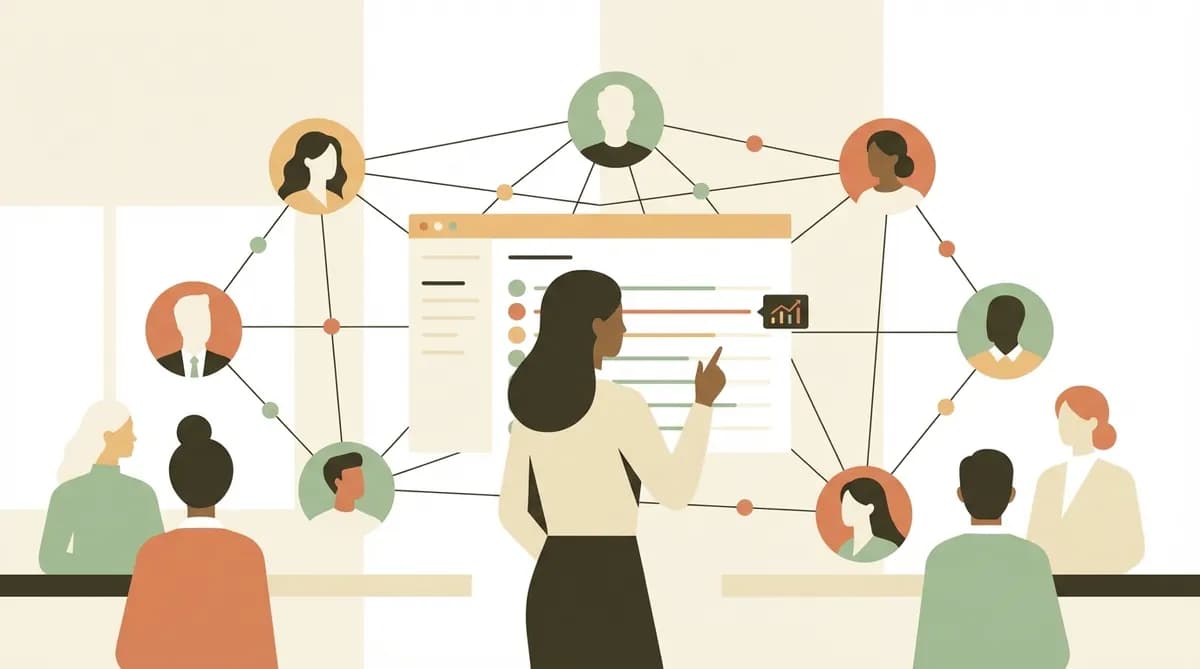
Some organizations use HRBPs. Others use skip-level meetings. Increasingly, companies are turning to conversational AI for HR — not chatbots that feel like filling out a form, but adaptive interview platforms that conduct genuine 360 conversations and follow up on what employees actually say.
The advantage of an AI-led conversation is consistency and psychological safety. The employee is not performing for a human audience. There is no power dynamic. And unlike a survey, the conversation adapts — if someone mentions workload, the system probes deeper into workload rather than moving to the next pre-set question.
An anonymized multi-site organization with a large distributed workforce replaced annual surveys with adaptive AI conversations and saw completion rates multiply by four.
many regions
Analysis that connects patterns across the organization
Individual conversations are valuable. Patterns across hundreds or thousands of conversations are transformative. When retention conversations are captured as structured qualitative data — not free-text comments that sit unread — HR can build a people analytics dashboard that shows retention risk by team, tenure cohort, geography, and role.
This is where the shift from reactive to proactive employee retention becomes operational. Instead of waiting for exit interview data to reveal problems after people have already left, organizations can identify emerging risks while there is still time to act.
Stay Interviews vs. Exit Interviews: Timing Changes Everything
The exit interview is the most widely used retention conversation format. It is also the least useful. By definition, it captures data from people who have already decided to leave. The insights are backward-looking, the employee has limited incentive to be fully candid (they may need a reference), and the organization can only apply lessons to future employees — not retain the one walking out the door.
Stay interviews — conversations specifically designed to understand what keeps current employees engaged — address the timing problem directly. Great Place to Work's guide to stay interviews outlines the core stay interview questions: What do you look forward to at work? What might tempt you to leave? What would you change if you could?
These questions are straightforward. The difficulty is execution at scale. A company with 500 employees conducting quarterly stay interviews needs 2,000 structured conversations per year. With 5,000 employees, it is 20,000. Manual approaches collapse under this weight, which is why most organizations either abandon stay interviews or run them inconsistently — which may be worse, since inconsistent execution creates the illusion of listening without the substance.
The exit interview software market has grown significantly, but the real opportunity lies upstream: technology that conducts stay conversations before the exit conversation becomes necessary.
Making Retention Conversations Work in Practice
For HR leaders looking to rebuild their retention conversation strategy, here is a practical sequence:
Start with your highest-risk populations. Do not try to roll out universal stay interviews on day one. Identify the roles, teams, or tenure cohorts with the highest turnover or the greatest business impact if someone leaves. For many organizations, this means retail frontline workers or manufacturing floor employees — populations that traditional engagement surveys consistently under-represent.
Separate the conversation from the manager relationship. This does not mean excluding managers. It means creating an additional channel — HRBP-led, peer-facilitated, or AI-driven — where employees can speak without filtering through the manager dynamic. Employee sentiment analysis powered by AI can process these conversations at scale, identifying themes a human reviewer would miss across thousands of data points.
Close the loop visibly. The fastest way to kill retention conversations is to collect input and do nothing with it. Employees who share concerns and see no response will not share again. When analysis surfaces a systemic issue — say, unclear promotion criteria in a specific division — the action taken must be visible and attributed. "Based on feedback from our team conversations, we are publishing promotion criteria for all engineering levels effective next quarter."
Measure conversation quality, not just completion. A retention conversation where the employee gives one-word answers is not a success. Track depth of response, topics surfaced, and follow-up actions generated — not just whether the conversation happened. This is where qualitative HR data provides insight that quantitative engagement surveys cannot.
From Conversations to Retention Intelligence
The organizations that retain talent effectively in 2026 are not the ones with the best exit interview template or the most comprehensive manager training deck. They are the ones that have built systems for continuous, structured, psychologically safe dialogue — and connected that dialogue to action.
The talent retention conversation is not a single event. It is infrastructure. It requires a channel employees trust, a frequency that matches the pace of organizational change, and an analytical layer that converts individual conversations into organizational intelligence.
When a company with a large distributed workforce across many regions needs to understand why mid-tenure retail managers are leaving at twice the historical rate, they cannot wait for an annual survey. They need real-time employee engagement data from adaptive conversations that happen continuously, analyze automatically, and surface patterns before they become crises.
The question is no longer whether retention conversations matter. It is whether your organization has the infrastructure to conduct them at the scale, frequency, and depth that actually moves the number.