Your executive committee does not need another dashboard telling them attrition rose last quarter. They need to know where the next rupture is forming, which teams are quietly losing confidence, which skills are becoming fragile, and what managers can still do while there is time.
That is the promise behind predictive HR analytics. It is also where many projects disappoint.
A model can rank employees by risk. A dashboard can show patterns by business unit. A workforce plan can project gaps against future demand. But if the underlying data is stale, overly standardized, or stripped of context, the prediction arrives as a number without a reason. HR knows where to look, but not what to say, what to change, or why the signal appeared.
What is predictive HR analytics?
Predictive HR analytics is the use of workforce data, statistical methods, and machine learning to estimate future people outcomes such as turnover, hiring demand, skills gaps, absenteeism, engagement risk, or internal mobility. Its value is not prediction alone. Its value is helping leaders act earlier, with better context.
Most guides define the field correctly. HR University describes predictive analytics as the move from descriptive reporting toward forecasting future workforce outcomes, including turnover, hiring success, performance, absenteeism, and workforce planning. HiBob frames predictive HR analytics as the analysis of past and present data to forecast future outcomes. SHRM’s coverage adds the essential management warning: predictive analytics helps only when companies ask the right questions.
The missing layer is input quality. Predictive HR analytics is only as useful as the employee reality it can observe.
Why traditional HR data weakens prediction
The standard HR data stack was not built to understand weak signals. It was built to administer employment: contracts, payroll, roles, grades, tenure, absence, performance cycles, learning records, and exits.
Those data points matter. They tell HR what changed. They rarely explain what is becoming unstable.
A turnover model can see that a team has higher absence, lower participation, fewer promotions, or more exits. It may infer risk. But it cannot know whether the real cause is a manager who stopped coaching, a schedule that makes family life impossible, a local process that creates constant rework, or a high-performing team whose know-how has never been transmitted.
This is why many predictive HR analytics programs become risk-scoring programs. They identify “who might leave” but not “what is happening here.” The organization learns to monitor symptoms instead of understanding causes.
For a deeper view on how analytics should move beyond static dashboards, see People Analytics Beyond Dashboards.
The problem with forms and periodic campaigns
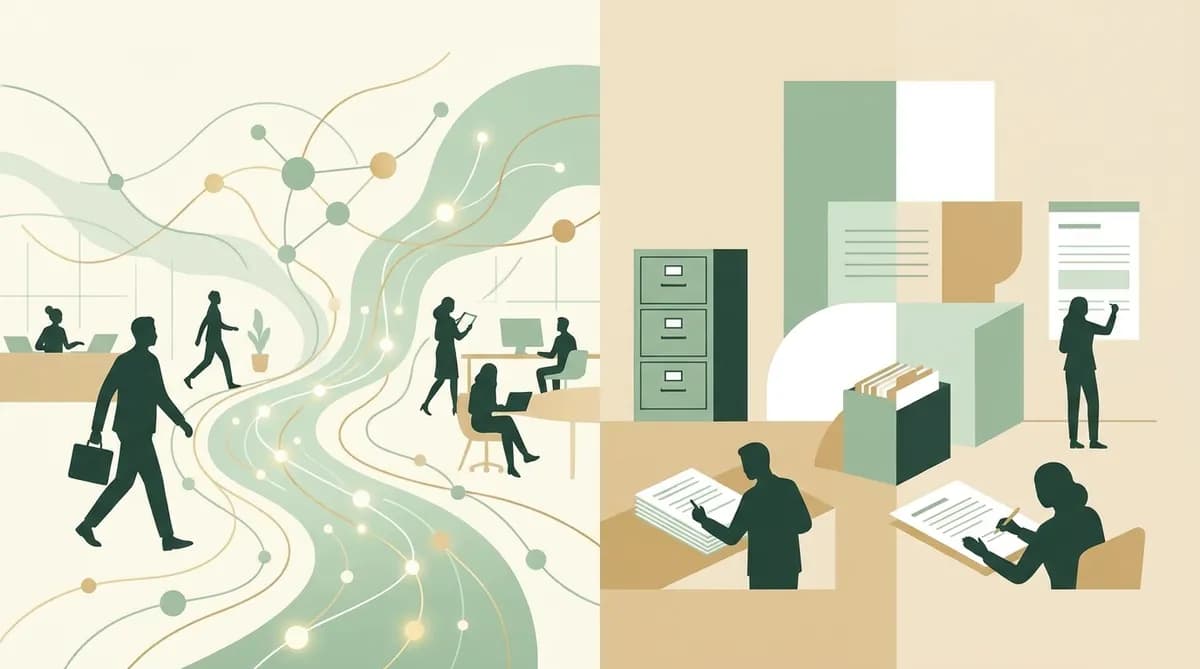
Standardized forms create comparable data. They do not always create useful truth.
Employees answer within the limits of the question. They compress nuance into ratings. They avoid sensitive topics when they do not trust how the data will be used. They skip the exercise when it feels disconnected from action. Leaders receive a clean chart, but the reasons behind the chart remain scattered in conversations, team rituals, manager notes, exit comments, and informal escalation paths.
Periodic campaigns add another constraint: timing. A quarterly or annual snapshot often arrives after the work environment has already shifted. In high-turnover environments, reorganizing teams, frontline operations, fast-growing tech companies, healthcare units, and manufacturing sites, the signal may change faster than the measurement cycle.
Predictive HR analytics needs fresher inputs. Not louder dashboards. Better conversations.
The better input: adaptive individual conversations
There is another way to feed predictive HR analytics: adaptive individual conversations that capture qualitative data continuously, in the employee’s preferred language and context.
Instead of asking every employee the same fixed path, the conversation adapts. If someone mentions workload, it explores workload. If they mention onboarding gaps, it follows the operational detail. If they describe a manager practice that helps the team perform, it captures the know-how. If they signal frustration, it seeks the concrete trigger without forcing a premature category.
This changes the role of people analytics. The organization is no longer limited to counting declared answers. It begins to build a living memory of what employees experience, what teams know, where execution breaks, and which local practices deserve to be transmitted.
Predictive HR analytics then becomes less about assigning risk to individuals and more about detecting patterns leaders can investigate, discuss, and act on.
Predictive HR analytics vs people analytics
People analytics is the broader discipline of using workforce data to improve people decisions. Predictive HR analytics is one branch of that discipline, focused on estimating what may happen next. The distinction matters because prediction without interpretation can create false confidence. Prediction must sit inside a wider decision process.
In practice, descriptive analytics answers “what happened,” diagnostic analytics asks “why,” predictive analytics estimates “what may happen,” and prescriptive analytics suggests “what action might help.” The strongest HR teams do not jump straight to prescription. They validate signals with context, conversation, and human judgment.
Nothing in HR should be decided by a score alone.
What predictive HR analytics can forecast
Predictive HR analytics is most useful when it targets a specific decision. Broad “talent risk” models tend to blur too many questions together. A better approach is to choose one operational problem and define the signal you need.
Common use cases include:
- Voluntary turnover risk by team, role, site, tenure band, or manager context
- Hiring demand and future capacity gaps
- Skills becoming scarce or unevenly distributed
- Onboarding cohorts that are struggling before they disengage
- Internal mobility patterns and succession fragility
- Engagement deterioration before it becomes attrition
- Manager practices correlated with stronger retention or performance
The connection to workforce planning is direct. A predictive model can estimate likely vacancies. But a living signal layer can explain whether the future gap is caused by demand growth, avoidable attrition, missing skills, weak onboarding, or know-how trapped in a few teams. For the full planning framework, read Workforce Planning: The Complete Guide for 2026.
A practical predictive HR analytics framework
Start with the business decision, not the model. “Reduce attrition” is too broad. “Identify operational teams where avoidable resignation risk is increasing and understand the causes early enough for managers to intervene” is usable.
Then define three layers of data.
First, cold data: HRIS records, tenure, role, location, compensation bands, absence, internal mobility, training history, performance cycles, and exit reasons.
Second, event data: reorganizations, manager changes, schedule changes, hiring freezes, new tools, workload peaks, site openings, policy changes, and business shocks.
Third, live data: ongoing employee conversations, onboarding feedback, stay interview themes, exit interview narratives, manager observations, team rituals, and local operating practices.
The third layer is where many HR teams are weakest. It is also where the most actionable signal lives.
From there, build a small number of models or signal views tied to intervention moments. A retention signal that cannot trigger a manager conversation, workload review, mobility discussion, or operating change is just another report.
What good predictive HR analytics outputs look like
A weak output says: “This employee has high attrition risk.”
A stronger output says: “Several employees in this role family are describing stalled progression, inconsistent manager feedback, and rising workload after the new process launch. Similar language appeared before previous resignations in comparable teams. Recommended next step: validate with the regional HRBP and prepare manager guidance.”
The difference is not cosmetic. The second output respects the employee, the manager, and the decision-maker. It treats prediction as a prompt for inquiry, not a verdict.
That is the threshold CHROs should demand from predictive HR analytics tools: explainable signals, human-readable evidence, clear governance, and a path from insight to action.
An anonymized example: from risk to transmission
In one large distributed organization, HR already had indicators that certain teams were harder to retain. The visible data showed uneven completion of HR processes, inconsistent engagement, and recurring local tension around execution. Traditional reporting could identify hotspots, but leaders still lacked the operational why.
The organization moved from declarative formats to adaptive individual conversations. Employees were not asked to fit their experience into a fixed grid. They could describe what made work easier, what slowed them down, what they had learned locally, and what they wished other teams understood.
The strongest signal was not a single complaint. It was a pattern: high-performing teams had developed very specific habits for onboarding, shift handover, local coaching, and informal problem-solving. Those practices were not in the official process. They lived in the craft of the best teams.
Once captured, the organization could query this memory. Leaders could ask what made one site more resilient than another. HR could distinguish a retention issue from a transmission issue. Managers could receive concrete practices from teams facing similar constraints.
Prediction became useful because it was connected to know-how.
In an anonymized case, completion multiplied by 4 by moving from declarative formats to adaptive individual conversations.
Anonymized case
The governance question: prediction is not permission
Predictive HR analytics deals with sensitive human data. That makes governance a design requirement, not a legal afterthought.
The model should never become a hidden decision-maker. Employees should understand what type of data is collected, why it is used, who can access it, and how it informs decisions. Managers should be trained to use signals as conversation starters, not labels. HR should audit for bias, data drift, and unfair treatment across populations.
This is especially important as public debate around AI in talent management grows. In March and April 2026, X trend summaries highlighted both enthusiasm for predictive talent analytics and concern about privacy, fairness, and resignation forecasting. The debate is healthy: workforce signals can help leaders support people earlier, but only if the system is transparent, proportionate, and governed by humans.
For regulated environments and European workforces, architecture also matters. Hosting, access controls, retention policy, consent, purpose limitation, and GDPR alignment are part of the product, not back-office details. See Conversational AI GDPR Compliant for the compliance lens.
What to ask before buying predictive HR analytics software
Before choosing a platform, ask questions that reveal whether the tool will improve decisions or merely decorate reporting.
Can it explain the signal in language HR and managers can understand? Can it combine HRIS data with qualitative employee conversations? Can it distinguish correlation from actionable evidence? Can it show trends at the right level of aggregation without exposing individuals unnecessarily? Can it support multilingual workforces without flattening nuance? Can it connect signals to retention, onboarding, engagement, workforce planning, and skills decisions?
Most importantly: can leaders query the organization?
That question changes the category. A dashboard answers the questions it was configured to answer. A living memory lets HR and executives ask new questions as reality changes: why are new hires struggling in one region, what do top-performing teams do differently, which skills are missing from current roles, where are managers asking for support, what changed after the reorganization?
That is where Craft Intelligence enters the conversation: not as another layer of reporting, but as a way to reveal the specific know-how of the organization and transmit it where it is needed.
Predictive HR analytics for workforce planning
Workforce planning fails when it treats headcount as the only variable. A team may have enough people and still lack the craft required to execute. Another may have vacancies but strong internal practices that protect continuity. A third may look stable until one expert leaves and takes undocumented know-how with them.
Predictive HR analytics improves workforce planning when it connects future demand with live workforce signals: skills, confidence, workload, manager practices, local constraints, and transmission gaps.
That means the planning conversation changes from “How many roles do we need?” to “Which capabilities must be strengthened, where is knowledge concentrated, which teams can teach others, and what risks are forming before they appear in attrition data?”
The future: from prediction to organizational memory
The next stage of predictive HR analytics will not be defined by more complex models alone. It will be defined by better organizational memory.
HR teams already have enough lagging indicators. They need live signals that preserve context, protect trust, and help leaders act with precision. The organizations that progress fastest will not be those that predict resignations with the most confidence. They will be those that understand what employees are telling them before resignation becomes the only remaining signal.
Predictive HR analytics should help the company learn from itself. It should reveal what the best teams know, where that know-how is missing, and what leaders can do while the window for action is still open.
Sources
- HR University, Predictive Analytics in HR: Examples and Complete Guide
- HiBob, What is predictive HR analytics?
- SHRM, Predictive Analytics Can Help Companies Manage Talent
- X Trending summary, AI Predicting Employee Turnover, April 1, 2026
- X Trending summary, Future of Work: AI in Talent Management, March 6, 2026