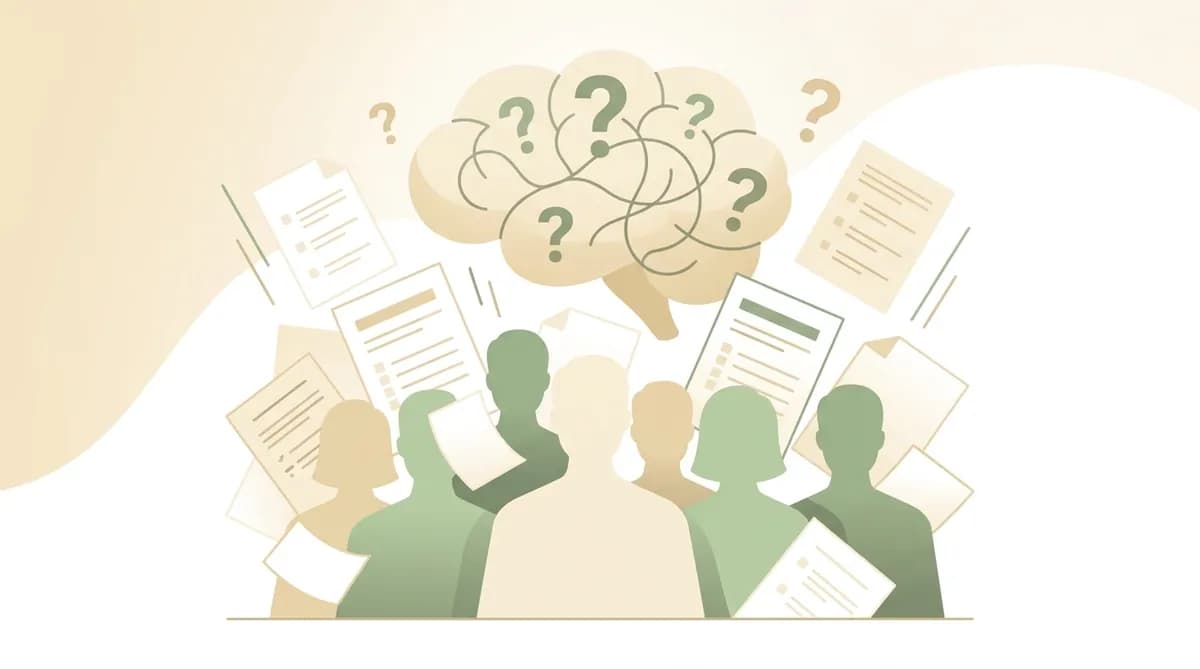
Your executive committee asks a familiar question: what is really happening in the organization?
The engagement score is flat. The latest pulse survey shows a small decline in manager trust. Comments mention workload, recognition, communication, and career growth. None of this is useless. But it does not tell you which teams are stuck, which managers have found better ways of working, which know-how is spreading, or why two sites facing the same pressure produce very different employee experiences.
That is the real problem behind the “pulse survey vs conversation” debate. It is not whether pulse surveys are bad. It is whether short, repeated forms can capture the level of context leaders need to act without guessing.
Pulse Survey vs Conversation: Short Definition
A pulse survey is a short, repeated questionnaire used to measure employee sentiment on specific topics over time. It is useful for tracking trends, comparing populations, and creating a shared management dashboard. Its limits appear when leaders need to understand the reasons, examples, exceptions, and local practices behind the score.
An employee conversation is an adaptive exchange that lets each person explain what is happening in their own words. Instead of forcing every employee through the same fixed path, it follows context, asks relevant follow-ups, and turns qualitative input into signals HR and leaders can use.
The practical difference is this: a pulse survey measures an answer. A conversation captures the reasoning behind it.
Why Pulse Surveys Became So Popular
Pulse surveys answered a real failure in annual engagement programs. Annual surveys were slow, heavy, and often disconnected from the pace of business. By the time results were analyzed, the team that raised the issue might have changed manager, reorganized, or stopped believing that feedback leads to action.
Competitor advice in this category is usually sound: keep pulse surveys short, run them frequently, protect anonymity, follow up transparently, and avoid asking questions if you will not act on the answers. Questback, Perceptyx, Gallup, Quantum Workplace, and TriNet all converge on these basics. They position pulse surveys as faster, narrower, and more actionable than traditional employee engagement surveys.
That is true as far as it goes. A short form is usually easier to complete than a long form. A focused question is usually easier to interpret than a broad annual index. A trend line is better than a once-a-year snapshot.
But this improvement still stays inside the same format: predefined questions, standardized scales, aggregated results, and a reporting cycle.
For a deeper view of survey alternatives, see Employee Survey Alternatives: The Complete Guide for People Leaders.
The Hidden Limit: You Only Learn What You Asked
A pulse survey improves frequency. It does not remove the main constraint of a survey: the organization decides the questions before employees describe reality.
That creates four blind spots.
First, the question may be right but too broad. “I have the tools I need to do my job” can hide staffing gaps, broken workflows, local workarounds, poor onboarding, unclear ownership, or a dependency on one experienced colleague.
Second, the answer may be accurate but incomplete. A team can rate communication poorly because leadership messages are unclear, because managers do not translate priorities, or because frontline employees hear important news from customers before they hear it internally.
Third, the same score can mean different things in different contexts. A low workload score in a warehouse, a support center, and a product team may point to entirely different root causes.
Fourth, the survey loses local know-how. The organization may learn that one region scores higher on onboarding, but not what its best managers actually do in week one, how they coach peers, or what rituals help new employees become productive faster.
This is where conversation changes the quality of the data.
What Conversations Capture That Pulse Surveys Miss
A conversation can ask: “What happened?” Then: “Can you give an example?” Then: “Who helped?” Then: “What would have made this easier?” Then: “Is this specific to your team, or common elsewhere?”
Those follow-ups matter. They turn an opinion into an observable signal.
In HR, the most useful data is often not a score. It is a pattern of lived situations: a repeated friction, a manager behavior, a handover that works, a skill gap that slows execution, a ritual that new hires remember, a local practice that could help another team.
That is why employee conversations are not just another feedback channel. They are a way to build organizational memory. When captured responsibly, structured, and made queryable, conversations help leaders ask better questions:
Which teams are struggling with manager availability?
Where do new employees mention unclear role expectations?
What do high-performing teams do differently during onboarding?
Which operational irritants appear repeatedly but never surface in dashboards?
Where is craft knowledge concentrated, and how can it be transmitted?
This is the shift from measuring employee voice to using employee voice as a living management asset.
Comparison: Pulse Survey vs Conversation
| Dimension | Pulse survey | Adaptive conversation |
|---|---|---|
| Format | Fixed questions and scales | Contextual exchange with follow-up |
| Best for | Trend tracking and benchmarks | Understanding causes, examples, and practices |
| Output | Scores, comments, dashboards | Qualitative signals, patterns, and memory |
| Frequency | Campaign-based | Continuous or triggered by key moments |
| Employee experience | Quick response | More personal and relevant |
| Risk | Surface-level answers, fatigue | Requires strong governance and trust |
| Leadership value | “Where are we up or down?” | “What is happening, why, and what can we learn?” |
The right question is not whether every company should delete pulse surveys. The better question is where pulse surveys stop being enough. For many organizations, surveys remain useful for broad temperature checks. Conversations become essential when leaders need to understand variation, transfer know-how, and act on context.
When a Pulse Survey Is Still the Right Tool
Pulse surveys work well when the organization needs a comparable signal across a large population. They are useful for checking whether a recent change is understood, whether employees feel informed, or whether a known topic is moving in the right direction.
They are also useful when the question is already clear. If leadership wants to know whether employees understand a new policy, a short pulse can be appropriate. If HR wants to compare confidence across regions after a communication campaign, a standardized scale has value.
The mistake is asking pulse surveys to do work they were not built to do. They can show that confidence is lower in one population. They cannot reliably explain the chain of events, local context, and informal practices that produced the difference.
For teams reviewing their engagement stack, Measuring Employee Engagement: The Complete Guide for 2026 gives the wider measurement context.
When Conversation Is the Better Format
Conversation is better when the topic is ambiguous, sensitive, operational, or deeply contextual.
Use it when the organization needs to understand why people leave, why they stay, how managers transmit know-how, where onboarding breaks down, what makes top teams effective, or why two similar populations report different experiences.
It is especially useful at moments where generic forms feel too thin: exit interviews, stay interviews, onboarding check-ins, performance review feedback, internal mobility conversations, and post-change listening.
In each case, the value is not only the individual answer. The value is the memory created across hundreds or thousands of conversations. Over time, HR can see recurring signals, compare contexts, and identify the practices worth transmitting.
The Trust Question: Employees Know the Difference
Employees can tell when an organization is listening to close the loop and when it is collecting input to fill a dashboard.
That distinction matters. A pulse survey can become tiring when employees see the same scales repeated without visible learning. A conversation can also fail if employees do not understand confidentiality, purpose, and governance.
The trust standard should be clear:
Data should be used to inform human decisions, not replace them.
Employees should know what will and will not be shared.
Individual comments should not become a back channel for surveillance.
Leaders should act on patterns, not hunt for authors.
The organization should communicate what it learned and what changed.
This is why the future of employee listening is not “more data” by itself. It is better-quality data, captured with a clear contract, and translated into decisions people can understand.
From Comments to Craft Intelligence
Open-text comments in pulse surveys are often treated as a supplement to the score. They are exported, tagged, summarized, and quoted in decks. That helps, but it still treats qualitative data as commentary around quantitative measurement.
Craft Intelligence starts from a different premise: the way people work contains know-how that can be revealed, preserved, and transmitted.
In this model, employee conversations do three jobs.
They listen to individual experience with enough context to make the signal meaningful.
They reveal the specific know-how of the best teams, not just their outcomes.
They help transmit that know-how to the teams that need it, in formats people can actually use.
The organization becomes queryable because its lived experience is no longer trapped in scattered interviews, manager notes, exit comments, or local habits. It becomes a living memory that HR, leaders, and teams can interrogate responsibly.
For a deeper view of qualitative signal, read Qualitative Engagement Data: How HR Turns Employee Voice Into Retention Signals.
An Anonymized Example: Same Topic, Different Outcome
A large distributed organization had already tried conventional listening formats. The problem was not a lack of intent. HR had recurring surveys, managers had action plans, and leadership had dashboards. Yet the same themes kept returning: onboarding inconsistency, manager overload, uneven transmission of good practices, and difficulty understanding what was really happening across locations.
The change came from replacing part of the declarative feedback process with adaptive individual conversations.
Instead of asking every employee to rate the same items, the conversation adapted to the person’s context. New joiners were asked about their first weeks. Experienced employees were asked where work really depended on informal know-how. Managers were asked what they repeated most often to help teams perform. Employees could describe friction, but also the practices that helped them succeed.
The useful insight was not a single complaint. It was the comparison between teams. Some locations had quietly built strong onboarding rituals: peer pairing, first-week checklists owned by the team, manager debriefs after peak periods, and practical explanations of customer situations. Other locations had the same official process but far less transmission.
That changed the management conversation. Instead of asking, “Why is this team lower?” leaders could ask, “What does the better-performing team actually do, and how do we help others learn it?” The listening process stopped being only diagnostic. It became a way to reveal craft.
In an anonymized case, completion multiplied by 4 by moving from declarative formats to adaptive individual conversations.
Anonymized case
How to Move From Pulse Surveys to Conversations
You do not need to replace every survey at once. The pragmatic path is to separate measurement needs from understanding needs.
Keep pulse surveys for topics where standardized tracking is valuable. Use conversations where the organization needs context, examples, root causes, and transferable practices.
Start with one high-signal moment. Onboarding, exit interviews, stay interviews, and engagement follow-ups are strong candidates because employees already have concrete experiences to describe. Avoid vague prompts. Ask about actual situations, blockers, decisions, and practices.
Design the governance before the first conversation. Define anonymity rules, access rights, escalation rules, data retention, and how insights will be shared. In Europe, make GDPR compliance a design condition, not a late legal review.
Create a taxonomy that can evolve. Do not trap every answer in static categories. Let recurring themes emerge, then structure them enough to compare across teams, regions, and time.
Close the loop with managers and employees. The point is not to create a larger listening archive. The point is to help humans make better decisions, improve work, and transmit what already works inside the organization.
For organizations that still rely heavily on forms, Employee Survey Limitations: What HR Teams Still Miss explains where the format breaks down.
Buying Criteria: What to Look For
If you are evaluating a pulse survey alternative, do not stop at the interface. The important criteria are deeper.
Look for adaptive conversation design, not a static form with friendlier wording.
Look for qualitative analysis that preserves context, not only sentiment scoring.
Look for multilingual capability that feels native for employees, especially in distributed organizations.
Look for memory: the ability to accumulate learning over time instead of restarting every campaign.
Look for queryability: HR and leaders should be able to ask precise questions across conversations, populations, and moments.
Look for governance: GDPR compliance, EU hosting where required, confidentiality controls, and clear human oversight.
Finally, look for transmission. Capturing employee voice is only half the work. The larger value comes when the organization can reveal what its best teams know and help others learn from it.
The Real Choice
The pulse survey vs conversation debate is not a technology preference. It is a management choice.
If you need a quick directional measure, a pulse survey may be enough. If you need to understand what is happening inside work, why it varies, and which practices should spread, you need conversations.
Scores can tell you where to look. Conversations tell you what to learn.
The organizations that will improve fastest are not the ones that ask employees more questions. They are the ones that build a living memory from what employees already know, then use it to make better human decisions.